Manual article / Aquaponics Production Manual
Feed
A sourced, attributed collection from its original edition.
On this page
Fish feed is the driving force behind the aquaponic system. Fish feed is primarily made up of protein, carbohydrate, and fat, with other ingredients like fiber, vitamins, minerals, and binders in smaller quantities. The nutrient components of these ingredients, whether pre-digested by the fish or simply broken down in the water, become the nutrient source for the plants in the system. However, for better or worse, these are the only nutrients available for plant crop growth, so fish feed input requires careful management. Table 5 outlines the feeding rate for fish based on body weight. To calculate the amount of feed needed to support plant and fish growth, Feed Conversion Ratio (FCR) must be calculated. The
FCR is a ratio of fish diet fed in relation to fish flesh gained. The ideal FCR is 1, or 1 pound of diet fed to 1 pound of fish growth, but a more realistic number is closer to 1.4-1.8. FCR is calculated using the following formula:
$$FCR = total\ feed\ input\ (g) ÷ total\ weight\ gain\ (g)$$
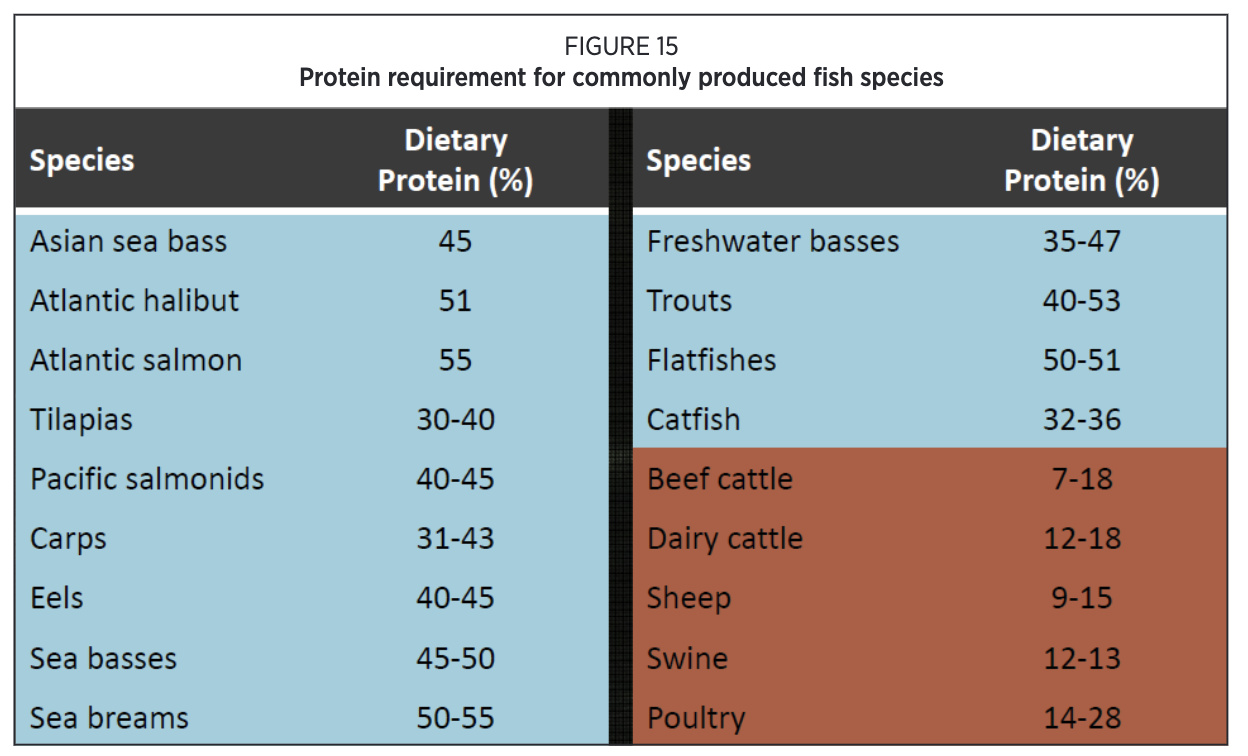
Protein is the limiting factor in fish growth but is also the most expensive dietary component. For these reasons, it is important to choose the appropriate diet for fish. Inadequate protein will reduce growth and too much protein is cost prohibitive and can lead to water quality issues. Figure 15 details protein requirements for commonly cultured fish species.
Before feed is purchased for production, practical considerations include fish age, feed size, protein/ carbohydrate content, floating vs. sinking pellets, length of time in storage, and feed storage area. The rule of thumb when choosing pellet size is that the pellet should be as big as the fish's mouth. As fish grow, so should the size of the pellet. Pellets are classified as float, slow sink, or sink, and the right choice depends on the species being fed. Feed manufacturers are able to give directions on the right type of feed for each production stage. Storing feed is actually a big consideration, as nutrient quality begins to decay after production. Feed storage in a dark, chilled or frozen environment is preferable, as it delays nutrient quality degradation but can introduce moisture resulting in moldy pellets. Molded feed must be thrown out, or composted into a garden, but must never be fed to fish, as it may contain toxins produced by the mold. Only enough feed should be purchased that can be fed in six months of straight production. When not used, feed should be kept in a cold, dry place with low relative humidity.
Table 5: Recommended feed chart for tank culture of Tilapia.
| Length (cm) | Average Weight (g) | Standard Feed Size | Range of Feeding Rate (% biomass/day) | Feeding Frequency |
| < 2.5 | < 0.5 | #00, #0, #1 Crumble | 20 – 15 | 4x per day |
| 2.5 - 6.4 | 0.5 – 5 | #2 Crumble | 15 – 10 | 4x per day |
| 6.4 - 10.2 | 5 – 18 | #3 Crumble | 10 – 5 | 4x per day |
| 10.2 – 15.2 | 18 – 75 | 1 mm | 5 – 3 | 3x per day |
| 15.2 – 20.3 | 75 – 150 | 1/8 inch (3 mm) | 3 – 1.5 | 3x per day |
| 20.3 – 33 | 150 – 450 | 3/16 inch (4 mm) | 3 – 1.5 | 2x per day |
| 33+ | > 450 | 3/16 inch (4 mm) | 1 | 1-2x per day |
*Reproduced and adapted from DeLong et al. (2009) and Sawyer, J.D. (2019).
Source: Janelle Hager, Leigh Ann Bright, Josh Dusci, James Tidwell. 2021. Kentucky State University. Aquaponics Production Manual: A Practical Handbook for Growers.
5.1 Formulated
Original publication · First published on FarmHub Learn · Kentucky State University
Formulated feeds are nutritionally complete pellets that are formulated for specific fish and life stage (Figure 15). Unlike other animal crops in agriculture, the nutritional needs of fish vary greatly among species for protein, fat, and carbohydrate inclusions. A carnivorous fish who eats at the top of its food chain, like a largemouth bass, requires a diet with high protein and low carbohydrates. On the other hand, omnivorous or herbivorous fish, like catfish or tilapia, require less protein and can tolerate higher levels of carbohydrate in their diets. This is important in aquaponics because the nutrient composition of the feed pellet drives the nutrient load available to the plants. As the fish feed is consumed and excreted by the fish, nutrients are released into the water as dissolved or solid particulates, which get circulated and used for plant growth. For example, feeds with a higher protein content will deliver a higher amount of total ammonia nitrogen (TAN) to the system, as nitrogen is primarily derived from the protein in the feed. The amount of TAN produced from a particular feed per day can be calculated using the following formula from Timmons and Ebeling (2013):
$\text{P}_{\text{TAN}} = \text{Feed input (g) x Protein content (%) x}\ ^*0.092 ÷ \text{time}$
*0.92 represents = 0.16 x 0.80 x 0.80 x 0.90
-
16% (protein is 16% N)
-
80% N is assimilated
-
80% assimilated N is excreted
-
90% of N excreted as TAN + 10% as urea
Example calculation for 2,000 g feed per day at 32% protein:
PTAN = 2,000 g x 0.32 x 0.092 ÷ 1 day
PTAN = 58.9 g
This rate is equivalent to approximately 3% of the feed rate per day.
Commercial aquaculture feeds are extruded so that they maintain their integrity in the water (i.e. they hold together and do not break apart easily when in contact with the water). Feed that is steam extruded will float, where feed that is pressure/temperature extruded will sink. Feeds can also be slow sink, which results from a combination of ingredient ratio (% inclusion of carbohydrate) and type of extrusion. The type of feed required will depend on the biology and feeding nature of the culture fish.
Source: Janelle Hager, Leigh Ann Bright, Josh Dusci, James Tidwell. 2021. Kentucky State University. Aquaponics Production Manual: A Practical Handbook for Growers.
5.2 Supplemental
Original publication · First published on FarmHub Learn · Kentucky State University
A common question among small-scale and hobby aquaponic growers is if they can feed vegetable scraps, insects, or loose grains to their fish. These are known as supplemental diets and only meet part of the nutrient requirement of the fish. This is sometimes seen in traditional aquaculture practices in which fish are contained in large bodies of water where they can scavenge additional foods from the environment. Because aquaponics is a completely closed system, a complete diet must be fed. In addition, if fish must expend energy to scavenge for loose food or scraps, they are not growing at their full potential. Providing all their required nutrition in one, appropriately sized pellet allows the fish to convert more of that energy into growth, rather than using it to find food.
Source: Janelle Hager, Leigh Ann Bright, Josh Dusci, James Tidwell. 2021. Kentucky State University. Aquaponics Production Manual: A Practical Handbook for Growers.
5.3 Alternative Diets
Original publication · First published on FarmHub Learn · Kentucky State University
Alternative diets are a great option to utilize bulk products that are a byproduct of another production system, non-traditional ingredients, or even agriculture scraps. These diets would be prepared on- site and would still be combined in a ratio to meet both the nutrient requirements of the fish and the plant crop. One area where this is seen is in the brewing of craft beer or spirits. The spent grains from the fermentation process (brewer's grains) typically have a protein content high enough to be used in combination with another protein component, again dependent on the crops to be grown. Also utilized are refuse from animal processing plants, scraps from crop harvest, or even earthworm or other insect sources. One newer insect meal being used is black soldier fly larvae (BSFL). This is an especially good protein source because the larvae can be "gut-loaded," or fed whatever precursor food would most benefit the fish consuming it, like foods high in Omega-3 fatty acids.
Source: Janelle Hager, Leigh Ann Bright, Josh Dusci, James Tidwell. 2021. Kentucky State University. Aquaponics Production Manual: A Practical Handbook for Growers.
Kentucky State University — Janelle Hager, Leigh Anne Bright, Josh Dusci, and James Tidwell.
View the original source edition
Reformatted and consolidated from the original web edition.