Manual article / Aquaponics Production Manual
Grow Out Management
A sourced, attributed collection from its original edition.
On this page
Proper management of fish and plants is a critical element that should be detailed in a production plan. Whether large or small scale, producers must implement strategies for best operation practices. This part of the plan should include, at minimum, fish and plant stocking densities, dates for planting and harvest, and their location or movement within the system (Bregnballe 2010). Additional components should include identification of a steady supply of fish year-round, maximization of space and resources, and a tailored or modified plan based on culture species and individual objectives.
- 4.1 Suitable Species of Fish for Culture
- 4.2 Species Overviews
- 4.3 Fingerling Production and Supply
- 4.4 Fish Stocking
- 4.5 Plants
Source: Janelle Hager, Leigh Ann Bright, Josh Dusci, James Tidwell. 2021. Kentucky State University. Aquaponics Production Manual: A Practical Handbook for Growers.
4.1 Suitable Species of Fish for Culture
Original publication · First published on FarmHub Learn · Kentucky State University
Unfortunately, not all fish species adapt well to tank culture, just as not all animal species adapt to being farm animals. Since fish are cold blooded, almost everything about their growth and health is influenced by temperature (see Tables 4 and 6 for details). The temperature of the culture water will partially dictate what species can or should be raised in your system. Other important factors will be how densely you intend to raise them and for what purpose or market. The rule of thumb for stocking density is 0.5 pound of fish weight per 1 gallon of water in grow out RAS. The following are considerations about what to grow for specific markets.
-
What is selling in your current stores or restaurants?
-
Can you address niche markets such as farmer's markets or are there minority groups in your area that have specific preferences?
-
What seasonal markets do you want to address?
-
What product forms will you be willing to address?
-
What is your ambient temperature for your growing period? What energy implications does that have? What is the cost?
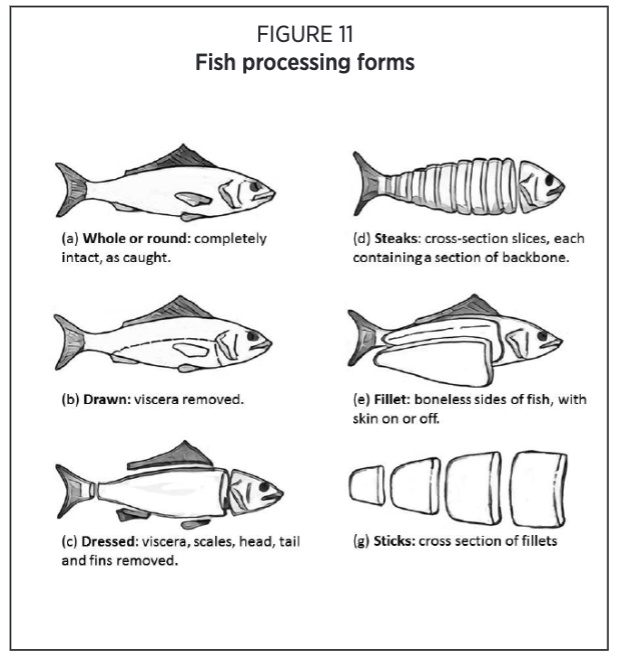
For some producers, fish are not an important part of the overall economics of the system and are primarily "nutrient generators" for the plants. For others, selling food fish is an important profit center for the aquaponics system. Aquaponic producers may have the benefit of providing a one-stop-shop for both fish and vegetables. If that is the case, the aquaponics producer should plan ahead on what their final fish product will be. Will the fish be sold live, whole on ice, or processed? For product forms, see Figure 11. Once you are selling processed fish, there are many more issues to be considered in terms of product form and processing regulations, such as:
-
Do you have access to a certified processing facility?
-
Do you have current HACCP regulations for the species you intend to process?
-
What does the packaging cost?
-
How will processing and packaging affect your budget?
Several fish species have been successfully cultured in aquaponic systems. Overall growth parameters of these are given in Table 4. Important factors when deciding on the proper species also include availability of quality brood-stock or fingerlings, growth rate to market size, and feed cost and supply. Freshwater species are preferred, as most of the plant crops produced in aquaponics have very low tolerance of salinity. Also, hybrid striped bass (Morone chrysops x M. saxatilis), which can be raised in aquaculture recycle systems, are reported to do poorly in aquaponics due to intolerance of the high potassium levels supplemented to support plant growth (Rackocy et al. 2006), though they have been grown successfully (Diessner 2013).
Table 4: Summary of fish species suitable for aquaponics.
| Species | Temperature (C) | Total ammonia nitrogen (mg/L) | Nitrite (mg/L) | Dissolved oxygen (mg/L) | Crude protein in feed (%) | Growth rate | Year-round supply of fingerlings (US) | Market value ($US/lb live) | Consumer Acceptance | |
| Vital | Optimal | |||||||||
| Nile tilapia Oreochromis niloticus | 4-34 | 25-30 | < 2 | < 1 | > 4 | 28-32 | 600g in 6–8months | Yes | $3.00 | Good |
| Common carp Cyprinus carpio | 14-36 | 27-30 | < 1 | < 1 | > 4 | 30-38 | 600g in 9–11months | Yes | NA | Poor |
| Channel catfish Ictalurus punctatus | 5-34 | 24-30 | < 1 | < 1 | < 3 | 25-36 | 400g in 9–10months | Yes | $2.00 | Good |
| Largemouth bass Micropterus salmoides | 5-34 | 24-30 | < 1 | < 2 | > 4 | 45-48 | 600g in 14-16months | Seasonal | $4.00- 5.00 | Moderate |
| Rainbow trout Oncorhynchus mykiss | 10-18 | 14-16 | < 0.5 | < 0.3 | > 6 | 42 | 1,000gin 14-16months | Seasonal | $3.00 | Good |
| BarramundiLates calcarifer | 18-34 | 26-29 | < 1 | < 1 | > 4 | 38-45 | 400g in 9–10months | No | $8.00- 9.00 | Good |
Source: Janelle Hager, Leigh Ann Bright, Josh Dusci, James Tidwell. 2021. Kentucky State University. Aquaponics Production Manual: A Practical Handbook for Growers.
4.2 Species Overviews
Original publication · First published on FarmHub Learn · Kentucky State University
Tilapia: Tilapia (usually Oreochromis niloticus or the Nile tilapia) are the most cultured fish in aquaponic systems. They are tolerant of both crowding and relatively poor water quality conditions. They do best at water temperatures of 25-30°C. At temperatures < 24°C, their growth slows substantially, and they become susceptible to disease. They breed readily and abundantly. In fact, if using mixed sex fish, unintended spawning in the system can be a problem particularly in DWC beds where tilapia will consume all available plant roots. Monosex fish (all male) are available and preferred. Tilapia are widely accepted in the marketplace. If available, ethnic markets, which accept live or whole fish, should be considered. The tilapia is most efficient when grown to ¾-1 lb. in final weight. For processed products, such as fillets, tilapia must be raised to large sizes since they have low fillet yields (33% of body weight) compared to other species.
Producers who choose to culture tilapia can be in competition with imported frozen product or with large domestic recycle systems, which drives down market price.
Common carp or Koi: The common carp and the Koi are the same species (Cyprinus carpio). The Koi is just a colorful genetic strain. Although widely consumed in other parts of the world, there is no food fish market for carp in the U.S. Carp are very hardy, have a wide temperature tolerance, and tolerate crowding and poor water quality. Fingerlings for stocking are usually readily available. They can be marketed as ornamentals, fetching high prices per fish. For systems that primarily use the fish as a source of organic nutrients, Koi can be a good choice because of their hardiness.
Channel catfish: The channel catfish (Ictalurus punctatus) is a major aquaculture production species in the southern U.S. It is widely accepted in the marketplace but brings a relatively low sale price, resulting in low profit potential. Ethnic consumers may pay higher prices for whole, quality catfish. Although a good pond culture species, the channel catfish is not as hardy as some people assume. In tanks they can be aggressive, and injury during feeding may occur from barbs located on the head of the fish. At water temperatures between 20-28°C, catfish are susceptible to a bacterial disease known as ESC (Enteric Septicemia of Catfish).
Largemouth bass: Largemouth bass (LMB, Micropterus salmoides) have become a relatively popular culture species. They bring high selling prices, as they have markets as both food fish and recreational stocking.
Bass will not readily accept artificial feeds as small fingerlings so producers must buy fish that have been feed trained. So far, LMB growth in tanks is much slower than for fish grown in ponds (Watts et al. 2016). Lack of domestication and confinement to the high-density environment of tanks contributes to additional time to harvest for tank-cultured LMB. LMB fingerlings are available most of the year from sportfish suppliers but the price differential is large. For example, in April or May, the price for a 2-3 inch fingerling is >$1.25 USD per fish, but in June they are $0.30-0.40 USD per fish. Two-inch feed-trained fingerlings are generally available in early June from suppliers in Arkansas and Alabama and 6-8" fingerlings are available in the late fall (usually November).
Rainbow trout: The rainbow trout has the longest history of culture of all the fish considered here. While the others are warm water species, the trout is a cold-water species with optimal temperatures of 14-16°C. Because they evolved in cold-water environments, they need high levels of dissolved oxygen and have little tolerance for poor water quality. Trout fingerlings are available in certain areas of the U.S. (Idaho and North Carolina) but are not always available in small numbers. If conditions are properly maintained, trout grow rapidly and are well received by consumers. Trout require a high protein feed, with a minimum of 45% for juveniles and adults. Trout production for small-scale producers is challenging due to the high cost of feed and competition with commercial markets.
Barramundi: The barramundi is a native of Southeast Asia and into Australia. Like the tilapia, it has been successfully raised in different production systems. It is often sold in restaurants and markets as Asian Sea Bass. It grows rapidly and produces a product that is well received. However, at present, there is no source of fingerlings in the U.S.
Source: Janelle Hager, Leigh Ann Bright, Josh Dusci, James Tidwell. 2021. Kentucky State University. Aquaponics Production Manual: A Practical Handbook for Growers.
4.3 Fingerling Production and Supply
Original publication · First published on FarmHub Learn · Kentucky State University
Fingerlings for fish culture can either be obtained from a supplier or produced in-house. Availability, price, number of fingerlings needed, and level of expertise are the main factors that determine the method of choice. Type of species cultured, season, and location can also heavily influence the methods.
Supply: The best option for small-scale producers is to buy from a supplier. Suppliers should maintain detailed breeding records, use high-quality broodstock, and implement Best Aquaculture Practices (BAPs). In the case of fish fingerlings, cheaper is not always better.
Knowing when fingerlings are available for purchase will help ensure quality fingerlings. Certain species such as bass, bluegill, and yellow perch fingerlings are considered seasonal and are easiest to find during the summer months after they have been feed-trained. Small fish that are available off-season will likely be stunted and would not achieve optimal growth rates. Species such as tilapia and koi can be bought consistently year-round.
Regardless of the supplier, anytime fish are purchased they should be handled properly, acclimated, and added into a quarantine system for 1-2 weeks to help prevent any disease/parasitic outbreaks within the main production system. If the fish are healthy at the end of the quarantine period, then they should be size graded and distributed into the main system. Addition of salt to the water during transportation and holding can prevent disease issues by reducing stress on the fish and result in a higher survival rate.
Information on salting for transport and holding can be found in SRAC Publication No. 390 (Wynne and Wurts 2011).
Production: If producing fingerlings in-house, the producer will need to determine the amount of fish needed to meet production demands. Typically, oversizing fingerling production is done to maintain maximum production capacity. Fingerling production will need to be done in a separate system to limit the spread of disease and to ensure optimal conditions for growth. The producer will also need additional tanks for broodstock, which should be of known lineage, age, and proper size (Egna and Boyd 1997).
Spawning can be natural or artificial but is typically natural in a commercial setting (Egna and Boyd 1997). The benefits of producing fingerlings in-house include cutting out the fingerling supplier, ensuring quality fingerlings, getting a quick supply of fingerlings, and potentially earning additional revenue from fingerling sales. Some downsides include the need for more space, need for quality broodstock, need for fingerling production expertise, and a higher initial investment.
Source: Janelle Hager, Leigh Ann Bright, Josh Dusci, James Tidwell. 2021. Kentucky State University. Aquaponics Production Manual: A Practical Handbook for Growers.
4.4 Fish Stocking
Original publication · First published on FarmHub Learn · Kentucky State University
Fish culture should be well planned, as mismanagement of densities within the system can lead to issues with nutrient build-up/deficiencies, solids accumulation, water quality concerns, and poor fish health. Consider that aquaponic systems typically do not operate with a fish density exceeding 0.5 pounds/gallon. Three of the most common fish production plans are sequential rearing, stock splitting, and multiple rearing units.
Sequential Rearing: Sequential rearing involves one tank, containing multiple age-groups of fish (Rackocy et al. 2006), where the market-sized population is selectively harvested, and fingerlings are restocked in equal number. While this seems manageable, the continuous grading required can be stressful on remaining stock, leading to increased risk of disease and death. In addition, stunted fish remain in the system, consuming feed that will not yield any return for operation costs. Carnivorous fish are not well suited for this management strategy, as younger fish are susceptible to predation.
Stock Splitting: Stock splitting requires accession of fingerlings at a high rate, followed by halving the population when tank biomass capacity is reached (Rackocy et al. 2006). Benefits include the ability to remove stunted fish and better control over inventory. However, moving the fish increases the risk of disease and fish loss. Swim ways, a permanent or temporary channel connecting tanks, have been successfully installed to limit stress on fish but accurate counts and weights of the fish are hard to ascertain.
Multiple Rearing Units: Operating multiple rearing units is the most popular method of fish stocking and management. This method utilizes several tanks connected by a common filtration system (Rackocy et al. 2006). When maximum biomass in one tank is achieved, the entire population is moved to a larger tank, typically connected via a hatch or swim way.
The University of the Virgin Islands (UVI) in St. Croix uses a variation on the multiple rearing unit system. They operate four fish tanks of the same size, with same-age fish in each, stocked in time increments. Fish grow from fingerling to market size in one tank, with no movement until harvest. In this scenario, there is always a tank that is either ready for or nearing harvest. While tank volume is not utilized efficiently, fish stress and labor costs are decreased, while knowledge of stock inventory is increased (Rackocy et al. 2006).
Source: Janelle Hager, Leigh Ann Bright, Josh Dusci, James Tidwell. 2021. Kentucky State University. Aquaponics Production Manual: A Practical Handbook for Growers.
4.5 Plants
Original publication · First published on FarmHub Learn · Kentucky State University
Stocking and harvesting strategies can also be implemented in the hydroponic portion of the system. The three most common strategies are staggered cropping, batch cropping, and intercropping (Rackocy et al. 2006). Their implementation and success depend on geographic location (tropical or temperate regions), crop variety (leafy vs. fruiting crops), and market demand.
Aquaponic producers typically grow leafy green crops, which have a lower value per unit value and high yield. Lettuce, Swiss chard, kale, basil, and other herbs are typically ready for harvest between 3-5 weeks from transplanting (6-8 weeks from seed), resulting in a steady income stream. Fruiting plants like tomatoes, cucumbers, and peppers take 10-16 weeks to harvest, resulting in longer growing periods and lower yields, but they have a higher individual value. Producers often grow a variety of crops to diversify their markets and reach a number of consumer groups.
It is critical to invest time in a production strategy that realistically evaluates inputs and product output. Market demands vary among countries, regions, and even among neighboring cities. Producers should calculate the real-estate value of their system, often in price per square foot. To illustrate this, a comparison between two types of lettuce can be used. Figure 12 shows two different types of lettuce grown at the University of Virgin Islands in St. Croix. Although Parris Island romaine has a higher individual value ($/ head) than Boston bibb, when the planting density and growth period are considered, Boston bibb brings a higher value per square meter of growing area per week than the Parris Island romaine. The main takeaway here is that high density and frequent harvests may an increased value, even when individual value of the crop is low. Information presented here is just an example and calculations should be tailored to a specific crops, farm, market, and regional costs for production.
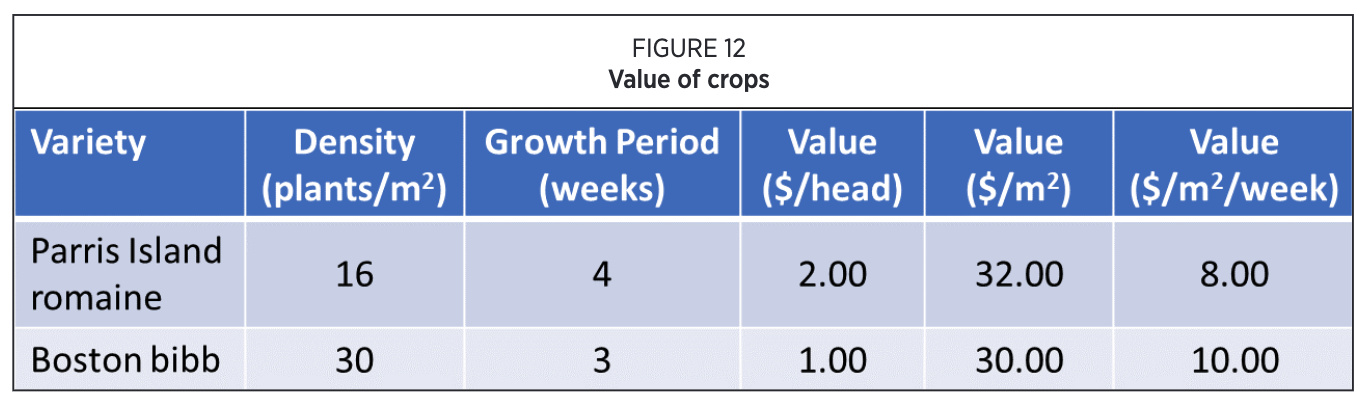
To understand if the crop is profitable, the cost of labor from seed to harvest, price of seed, propagation supplies, and retail packaging will need to be subtracted from the price/m2/week. If the selling price is below that of its "real-estate value," the hydroponic portion may be operating at a loss. In addition, producers may have multiple harvests from the same crop. Kale and Swiss chard are crops that can sustain multiple harvests without a decrease in quality of the produce, therefore increasing the value of that real estate. The strategies included here are not a comprehensive list but can be developed and adapted for individual plants.
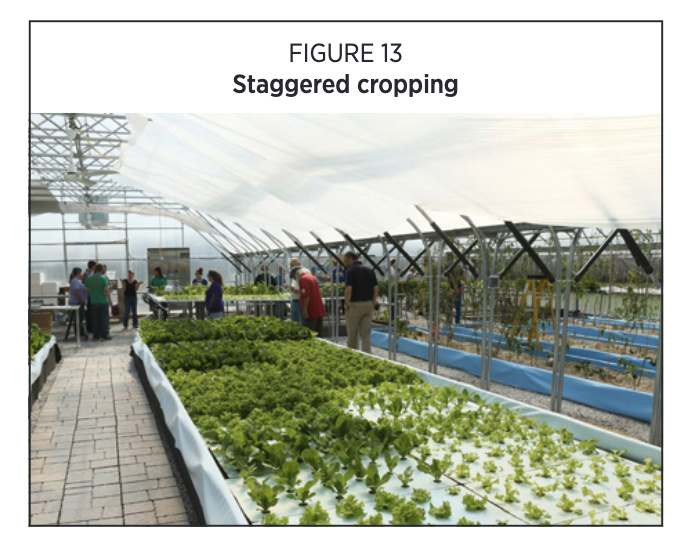
Staggered Crops: Staggered cropping is growing multiple stages of crops in the same system and typically allows a consistent and regular harvest to be maintained (Somerville et al. 2014) (Figure 13).
For example, if a head of lettuce takes three weeks to reach maturity, three stages are cultivated at the same time, resulting in a weekly harvest. This method is used with crops that are ready for harvest in a short time, usually leafy greens or herbs. This method maintains a constant nutrient uptake by the plants, resulting in better control of the system and water quality parameters, making system management and outputs more predictable.
Batch Crops: Batch cropping is commonly used when a longer growing period is required, such as with tomatoes and cucumbers. Produce is collected in batches as it ripens or becomes available.
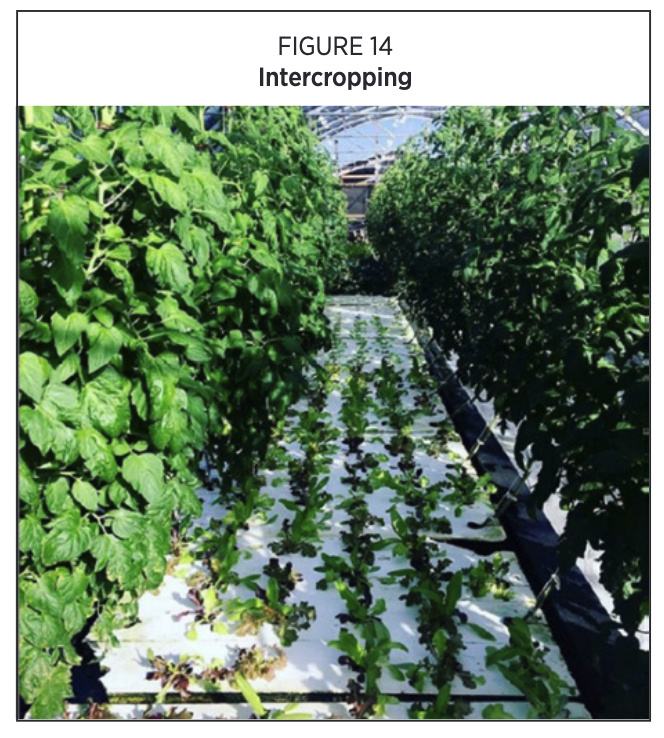
Intercropping: Some producers will intercrop their plants, meaning crops with a short time to harvest are planted along with larger, fruiting ones (Figure 14). For example, if a producer is growing lettuce and tomatoes together, the lettuce crop can be harvested before the canopy of the tomatoes grows tall enough to shade it out.
Source: Janelle Hager, Leigh Ann Bright, Josh Dusci, James Tidwell. 2021. Kentucky State University. Aquaponics Production Manual: A Practical Handbook for Growers.
Kentucky State University — Janelle Hager, Leigh Anne Bright, Josh Dusci, and James Tidwell.
View the original source edition
Reformatted and consolidated from the original web edition.