Manual article / Small-scale Aquaponic Food Production
Understanding aquaponics
A sourced, attributed collection from its original edition.
On this page
Building from the initial explanation of aquaponics in Chapter 1, this chapter discusses the biological processes occurring within an aquaponic unit. First, the chapter explains the major concepts and processes involved, including the nitrification process. It then examines the vital role of bacteria and their key biological processes. Finally, there is a discussion of the importance of balancing the aquaponic ecosystem consisting of the fish, plants and bacteria, including how this can be achieved while maintaining an aquaponic unit over time.
Balancing the aquaponic ecosystem
Original publication · First published on FarmHub Learn · Food and Agriculture Organization of the United Nations
The term balancing is used to describe all the measures an aquaponic farmer takes to ensure that the ecosystem of fish, plants and bacteria is at a dynamic equilibrium. It cannot be overstated that successful aquaponics is primarily about maintaining a balanced ecosystem. Simply put, this means that there is a balance between the amount of fish, the amount of plants and the size of the biofilter, which really means the amount of bacteria. There are experimentally determined ratios between biofilter size, planting density and fish stocking density for aquaponics. It is unwise, and very difficult, to operate beyond these optimal ratios without risking disastrous consequences for the overall aquaponic ecosystem. Advanced aquaponic practitioners are invited to experiment and adjust these ratios, but it is recommended to begin aquaponics following these ratios. This section provides a brief, but essential, introduction to balancing a system. Biofilter sizes and stocking densities are covered in much greater depth in Chapter 8.
Nitrate balance
The equilibrium in an aquaponic system can be compared with a balancing scale where fish and plants are the weights standing at opposite arms. The balance's arms are made of nitrifying bacteria. It is thus fundamental that the biofiltration is robust enough to support the other two components. This corresponds to the thickness of the lever in Figure 2.10. Note that the arms were not strong enough to support the amount of fish waste and that the arm broke. This means that the biofiltration was insufficient.
If the fish biomass and biofilter size are in balance, the aquaponic unit will adequately process the ammonia into nitrate. However, if the plant component is undersized, then the system will start to accumulate nutrients (Figure 2.11). In practical terms, higher concentrations of nutrients are not harmful to fish nor plants, but they are an indication that the system is underperforming on the plant side.
A common management mistake is when too many plants and too few fish are used, as seen in the third scenario shown in Figure 2.12. In this case, ammonia is processed by nitrifying bacteria, but the amount of resulting nitrate and other nutrients is insufficient to cover the plants' needs. This condition eventually leads to a progressive reduction in nutrient concentrations and, consequently, plant yields.
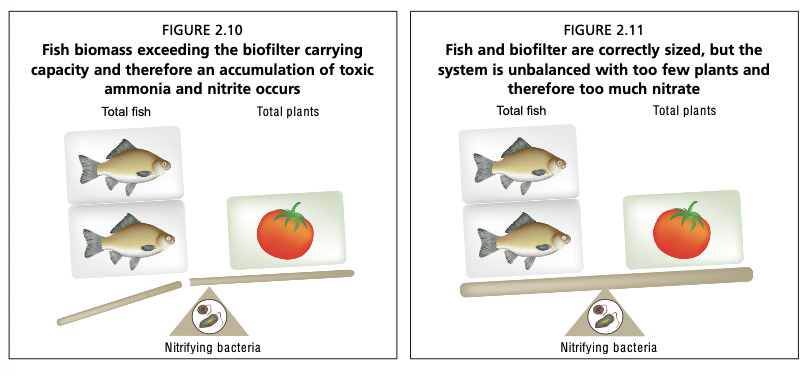
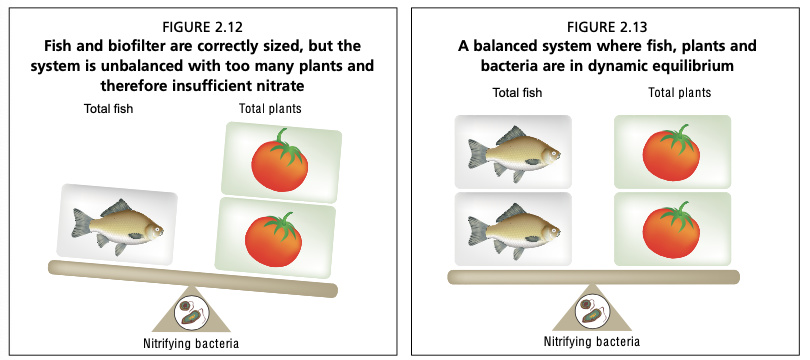
The major lesson from both examples is that achieving maximum production from aquaponics requires the maintaining of an appropriate balance between fish waste and vegetable nutrient demand, while ensuring adequate surface area to grow a bacterial colony in order to convert all the fish wastes. This balanced scenario is shown in Figure 2.13. This balance between fish and plants is also referred to as the biomass ratio. Successful aquaponic units have an appropriate biomass of fish in relation to the number of plants, or more accurately, the ratio of fish feed to plant nutrient demand is balanced. Although it is important to follow the suggested ratios for good aquaponic food production, there is a wide range of workable ratios, and experienced aquaponic farmers will notice how aquaponics becomes a self-regulating system. Moreover, the aquaponic system provides an attentive farmer with warning signs as the system begins to slip out of balance, in the form of water-quality metrics and the health of the fish and plants, all of which are discussed in detail throughout this publication.
Feed rate ratio
Many variables are considered when balancing a system (see Box 2), but extensive research has simplified the method of balancing a unit to a single ratio called the feed rate ratio. The feed rate ratio is a summation of the three most important variables, which are: the daily amount of fish feed in grams per day, the plant type (vegetative vs. fruiting) and the plant growing space in square metres. This ratio suggests the amount
BOX 2 The main variables to consider when balancing a unit
Recommended daily fish feed rates are:
|
of daily fish feed for every square metre of growing space. It is more useful to balance a system on the amount of feed entering the system than it is to calculate the amount of fish directly. By using the amount of feed, it is then possible to calculate how many fish based on their average daily consumption.
The feed rate ratios will provide a balanced ecosystem for the fish, plants and bacteria, provided there is adequate biofiltration. Use this ratio when designing an aquaponic system. It is important to note that the feed rate ratio is only a guide to balancing an aquaponic unit, as other variables may have larger impacts at different stages in the season, such as seasonal changes in water temperature. The higher feed rate ratio for fruiting vegetables accounts for the greater amount of nutrients needed for these plants to produce flowers and fruits compared with leafy green vegetables.
Along with the feed rate ratio, there are two other simple and complementary methods to ensure a balanced system: health check, and nitrogen testing.
Health check of fish and plants
Unhealthy fish or plants are often a warning that the system is out of balance. Symptoms of deficiencies on the plants usually indicate that not enough nutrients from fish waste are being produced. Nutrient deficiencies often manifest as poor growth, yellow leaves and poor root development, all of which are discussed in Chapter 6. In this case, the fish stocking density, feed (if eaten by fish) and biofilter can be increased, or plants can be removed. Similarly, if fish exhibit signs of stress, such as gasping at the surface, rubbing on the sides of the tank, or showing red areas around the fins, eyes and gills, or in extreme cases dying, it is often because of a buildup of toxic ammonia or nitrite levels. This often happens when there is too much dissolved waste for the biofilter component to process. Any of these symptoms in the fish or plants indicates that the farmer needs to actively investigate and rectify the cause.
Nitrogen Testing
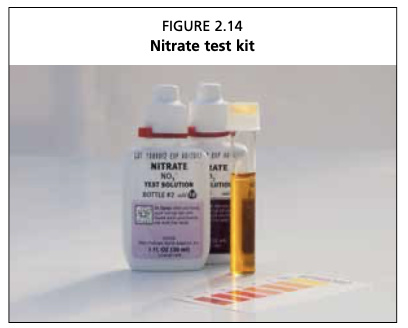
This method involves testing the nitrogen levels in the water using simple and inexpensive water test kits (Figure 2.14). If ammonia or nitrite are high (> 1 mg/litre), it indicates that the biofiltration is inadequate and the biofilter surface area available should be increased. Most fish are intolerant of these levels for more than a few days. An increasing level of nitrate is desired, and implies sufficient levels of the other nutrients required for plant growth. Fish can tolerate elevated levels of nitrate, but if the levels remain high (> 150 mg/litre) for several weeks some of the water should be removed and used to irrigate other crops.
If nitrate levels are low (< 10 mg/litre) over a period of several weeks, the fish feed can be increased slightly to make sure there are enough nutrients for the vegetables. However, never leave uneaten fish feed in the aquaculture tank, so increasing the stocking density of the fish may be necessary. Alternatively, plants can be removed so that there are enough nutrients for those that remain. It is worthwhile and recommended to test for nitrogen levels every week to make sure the system is properly balanced. Moreover, nitrate levels are an indicator of the level of other nutrients in the water.
Again, all of the calculations and ratios mentioned above, including fish stocking density, planting capacity and biofilter sizes, are explained in much greater depth in the following chapters (especially in Chapter 8). The aim of this section was to provide an understanding of how vital it is to balance the ecosystem within aquaponics and to highlight the simple methods and strategies to do so.
Source: Food and Agriculture Organization of the United Nations, 2014, Christopher Somerville, Moti Cohen, Edoardo Pantanella, Austin Stankus and Alessandro Lovatelli, Small-scale aquaponic food production, http://www.fao.org/3/a-i4021e.pdf. Reproduced with permission.
Important biological components of aquaponics
Original publication · First published on FarmHub Learn · Food and Agriculture Organization of the United Nations
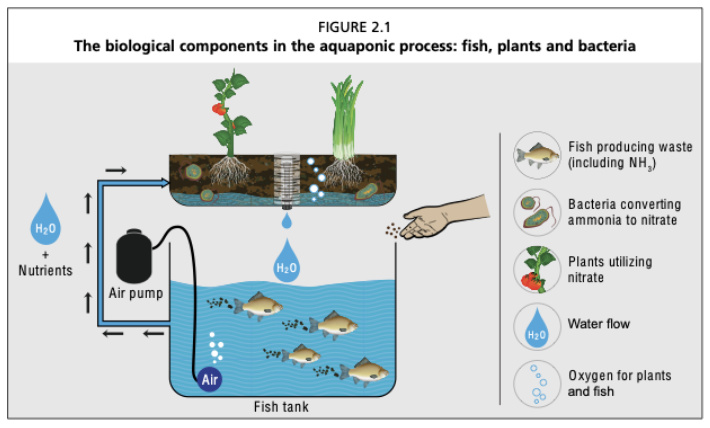
As described in Chapter 1, aquaponics is a form of integrated agriculture that combines two major techniques, aquaculture and hydroponics. In one continuously recirculating unit, culture water exits the fish tank containing the metabolic wastes of fish. The water first passes through a mechanical filter that captures solid wastes, and then passes through a biofilter that oxidizes ammonia to nitrate. The water then travels through plant grow beds where plants uptake the nutrients, and finally the water returns, purified, to the fish tank (Figure 2.1). The biofilter provides a habitat for bacteria to convert fish waste into accessible nutrients for plants. These nutrients, which are dissolved in the water, are then absorbed by the plants. This process of nutrient removal cleans the water, preventing the water from becoming toxic with harmful forms of nitrogen (ammonia and nitrite), and allows the fish, plants, and bacteria to thrive symbiotically. Thus, all the organisms work together to create a healthy growing environment for one another, provided that the system is properly balanced.
The nitrogen cycle
The most important biological process in aquaponics is the nitrification process, which is an essential component of the overall nitrogen cycle seen in nature. Nitrogen (N) is a chemical element and an essential building block for all life forms. It is present in all amino acids, which make up all proteins which are essential for many key
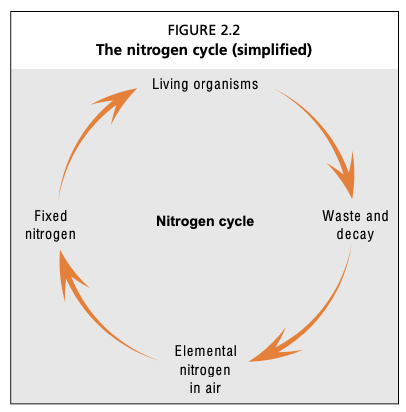
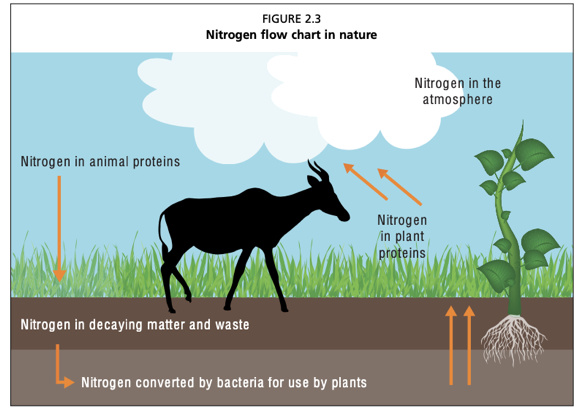
biological processes for animals such as enzyme regulation, cell signalling and the building of structures. Nitrogen is the most important inorganic nutrient for all plants. Nitrogen, in gas form, is actually the most abundant element present in the Earth's atmosphere making up about 78 percent of it, with oxygen only making up 21 percent. Yet, despite nitrogen being so abundant, it is only present in the atmosphere as molecular nitrogen (N2), which is a very stable triple bond of nitrogen atoms and is inaccessible to plants. Therefore, nitrogen in its N2 form has to be changed before plants use it for growth. This process is called nitrogen-fixation. It is part of the nitrogen cycle (Figure 2.2), seen throughout nature (Figure 2.3). Nitrogen- fixation is facilitated by bacteria that chemically alter the N2 by adding other elements such as hydrogen or oxygen, thereby creating new chemical compounds such as ammonia (NH3) and nitrate (NO3-) that plants can easily use. Also, atmospheric nitrogen can be fixed through an energy-intensive manufacturing process known as the Haber Process, used to produce synthetic fertilizers.
The animal represented in Figure 2.3 produces waste (faeces and urine) that is largely made of ammonia (NH3). Other decaying organic matter found in nature, such as dead plants or animals, is broken down by fungi and different bacteria groups into ammonia. This ammonia is metabolized by a specific group of bacteria, which is very important for aquaponics, called nitrifying bacteria. These bacteria first convert the ammonia into nitrite compounds (NO2-) and then finally into nitrate compounds (NO3-). Plants are able to use both ammonia and nitrates to perform their growth processes, but nitrates are more easily assimilated by their roots.
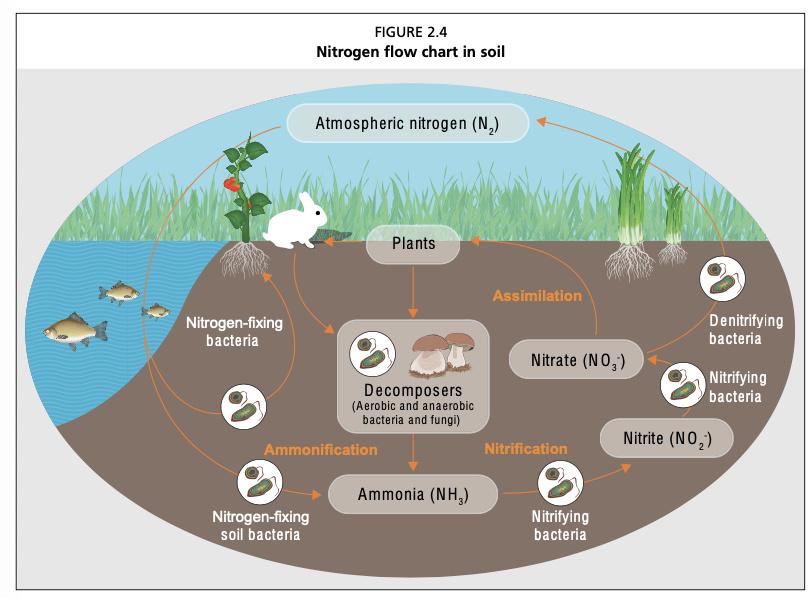
Nitrifying bacteria, which live in diverse environments such as soil, sand, water and air, are an essential component of the nitrification process that converts plant and animal waste into accessible nutrients for plants. Figure 2.4 shows the same process as that illustrated in Figure 2.3, but includes a more complex flow chart showing all the stages of the nitrogen cycle.
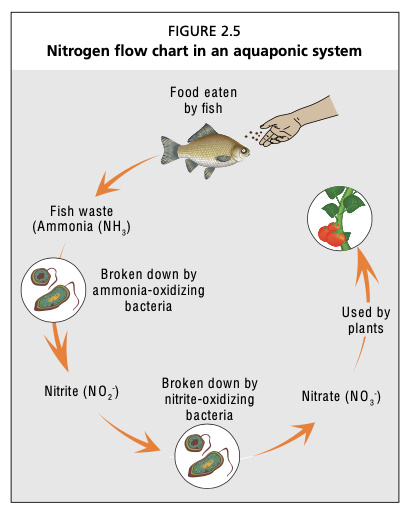
This natural process of nitrification by bacteria that happens in soil also takes place in water in the same way. For aquaponics, the animal wastes are the fish excreta released in the culture tanks. The same nitrifying bacteria that live on land will also naturally establish in the water or on every wet surface, converting ammonia from fish waste into the easily assimilated nitrate for plants to use. Nitrification in aquaponic systems provides nutrients for the plants and eliminates ammonia and nitrite which are toxic (Figure 2.5).
Source: Food and Agriculture Organization of the United Nations, 2014, Christopher Somerville, Moti Cohen, Edoardo Pantanella, Austin Stankus and Alessandro Lovatelli, Small-scale aquaponic food production, http://www.fao.org/3/a-i4021e.pdf. Reproduced with permission.
Maintaining a healthy bacterial colony
Original publication · First published on FarmHub Learn · Food and Agriculture Organization of the United Nations
The major parameters affecting bacteria growth that should be considered when maintaining a healthy biofilter are adequate surface area and appropriate water conditions.
Surface area
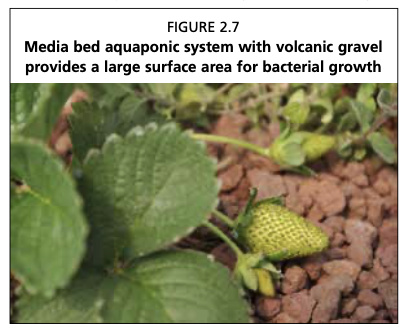
Bacterial colonies will thrive on any material, such as plant roots, along fish tank walls and inside each grow pipe. The total available area available for these bacteria will determine how much ammonia they are able to metabolize. Depending on the fish biomass and system design, the plant roots and tank walls can provide adequate area. Systems with high fish stocking density require a separate biofiltration component where a material with a high surface area is contained, such as inert grow media - gravel, tuff or expanded clay (Figure 2.7).
Water pH
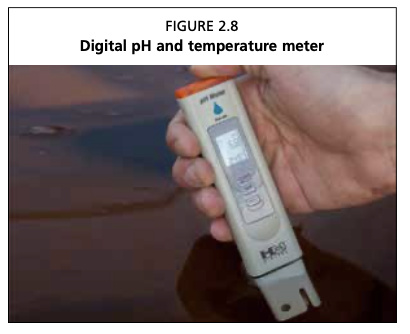
The pH is how acidic or basic the water is. The pH level of the water has an impact on the biological activity of the nitrifying bacteria and their ability to convert ammonia and nitrite (Figure 2.8). The ranges for the two nitrifying groups below have been identified as ideal, yet the literature on bacteria growth also suggests a much larger tolerance range (6-8.5) because of the ability of bacteria to adapt to their surroundings.
| Nitrifying bacteria | Optimal pH |
|---|---|
| Nitrosomonas spp. | 7.2-7.8 |
| Nitrobacter spp. | 7.2-8.2 |
However, for aquaponics, a more appropriate pH range is 6-7 because this range is better for the plants and fish (Chapter 3 discusses the compromise on water quality parameters). Moreover, a loss of bacterial efficiency can be offset by having more bacteria, thus biofilters should be sized accordingly.
Water temperature
Water temperature is an important parameter for bacteria, and for aquaponics in general. The ideal temperature range for bacteria growth and productivity is 17 -34 °C. If the water temperature drops below 17 °C, bacteria productivity will decrease. Below 10 °C, productivity can be reduced by 50 percent or more. Low temperatures have major impacts on unit management during winter (see Chapter 8).
Dissolved oxygen
Nitrifying bacteria need an adequate level of dissolved oxygen (DO) in the water at all times in order to maintain high levels of productivity.
Nitrification is an oxidative reaction, where oxygen is used as a reagent; without oxygen, the reaction stops. Optimum levels of DO are 4 -8 mg/litre. Nitrification will decrease if DO concentrations drop below 2.0 mg/ litre. Moreover, without sufficient DO concentrations, another type of bacteria can grow, one that will convert the valuable nitrates back into unusable molecular nitrogen in an anaerobic process known as denitrification.
Ultraviolet light
Nitrifying bacteria are photosensitive organisms, meaning that ultraviolet (UV) light from the sun is a threat. This is particularly the case during the initial formation of the bacteria colonies when a new aquaponic system is set up. Once the bacteria have colonized a surface (3 -5 days), UV light poses no major problem. A simple way to remove this threat is to cover the fish tank and filtration components with UV protective material while making sure no water in the hydroponic component is exposed to the sun, at least until the bacteria colonies are fully formed.
Nitrifying bacteria will grow on material with a high surface area (Figure 2.9), sheltered using UV protective material, and under appropriate water conditions (Table 2.1).
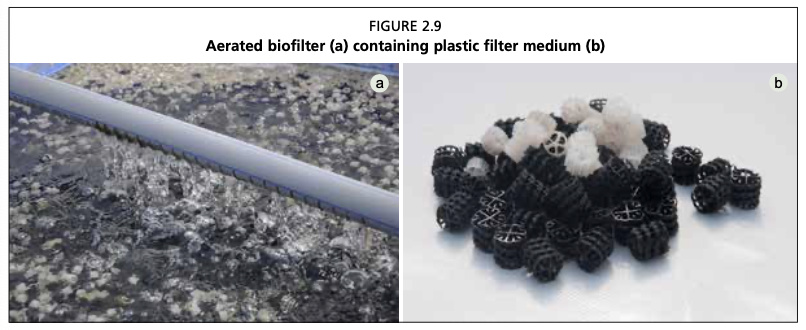
TABLE 2.1
Water quality tolerance ranges for nitrifying bacteria
| Temperature (°C) | pH | Ammonia (mg/litre) | Nitrite (mg/litre) | Nitrate (mg/litre) | DO (mg/litre) | |
|---|---|---|---|---|---|---|
| Tolerance Range | 17 -34 | 6 -8.5 | < 3 | < 3 | < 400 | 4 -8 |
Source: Food and Agriculture Organization of the United Nations, 2014, Christopher Somerville, Moti Cohen, Edoardo Pantanella, Austin Stankus and Alessandro Lovatelli, Small-scale aquaponic food production, http://www.fao.org/3/a-i4021e.pdf. Reproduced with permission.
The biofilter
Original publication · First published on FarmHub Learn · Food and Agriculture Organization of the United Nations
Nitrifying bacteria are vital for the overall functioning of an aquaponic unit. Chapter 4 describes how the biofilter component for each aquaponic method works, and Chapter 5 describes the different bacteria groups that operate in an aquaponic unit. Two major groups of nitrifying bacteria are involved in the nitrification process: 1) the ammonia-oxidizing bacteria (AOB), and 2) the nitrite-oxidizing bacteria (NOB) (Figure 2.6). They metabolize the ammonia in the following order:
-
AOB bacteria convert ammonia (NH₃) into nitrite (NO₂-)
-
NOB bacteria then convert nitrite (NO₂-) into nitrate (NO₃-)
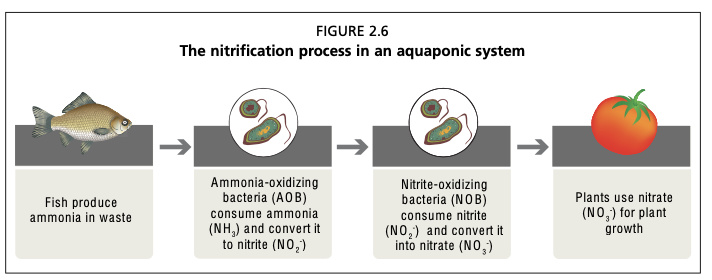
As shown in the chemical symbols, the AOB oxidize (add oxygen to) the ammonia and create nitrite (NO₂-) and the NOB further oxidize the nitrite (NO₂-) into nitrate (NO₃-). The genus Nitrosomonas is the most common AOB in aquaponics, and the genus Nitrobacter is the most common NOB; these names are frequently used interchangeably in the literature and are used throughout this publication.
In summary, the ecosystem within the aquaponic unit is totally reliant on the bacteria. If the bacteria are not present or if they are not functioning properly, ammonia concentrations in the water will kill the fish. It is vital to keep and manage a healthy bacterial colony in the system at all times in order to keep ammonia levels close to zero.
Source: Food and Agriculture Organization of the United Nations, 2014, Christopher Somerville, Moti Cohen, Edoardo Pantanella, Austin Stankus and Alessandro Lovatelli, Small-scale aquaponic food production, http://www.fao.org/3/a-i4021e.pdf. Reproduced with permission.
Food and Agriculture Organization of the United Nations — Christopher Somerville, Moti Cohen, Edoardo Pantanella, Austin Stankus, and Alessandro Lovatelli.
View the original source edition
Reformatted and consolidated from the original edition.