Manual article / Aquaponics Production Manual
Controlled Environment Growing
A sourced, attributed collection from its original edition.
On this page
- 9.1 Types of Greenhouses
- 9.2 Greenhouse Covering Options
- 9.3 Heating and Cooling Options
- 9.4 Indoor Production
Source: Janelle Hager, Leigh Ann Bright, Josh Dusci, James Tidwell. 2021. Kentucky State University. Aquaponics Production Manual: A Practical Handbook for Growers.
9.1 Types of Greenhouses
Original publication · First published on FarmHub Learn · Kentucky State University
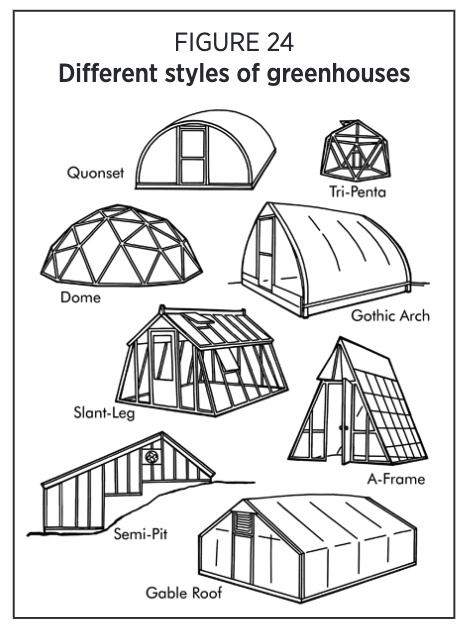
Free-standing greenhouses come in a variety of shapes and sizes (Figure 24). Choice of greenhouse depends on snow load and wind speed of a particular location. Free-standing greenhouses are less expensive than larger structures and are easier to optimize environmental parameters for different crop species. If multiple stand-alone structures are used, increased sanitation protocols are required to prevent insect pest and disease issues from being transferred between structures by workers.
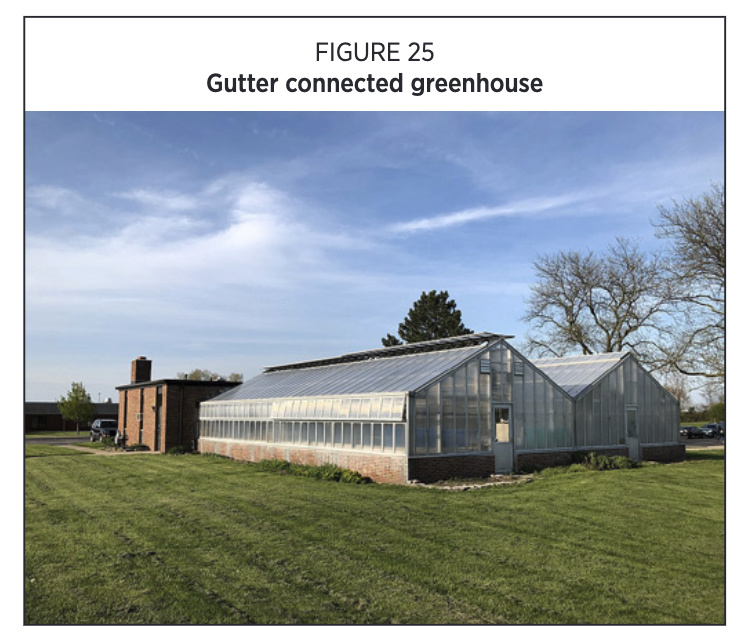
Gutter-connected greenhouses provide a more efficient use of space and reduced overall heating costs during winter compared to stand- alone structures (Figure 25). The upfront cost of this greenhouse style is high and may be cost prohibitive for growers on a limited budget.
Lean-to greenhouses have one wall that borders a building. Light reduction is not severe if the dark wall is the north wall. These types of structures may be useful for decoupled aquaponic systems, as environmental parameters can be controlled independently in each structure.
Source: Janelle Hager, Leigh Ann Bright, Josh Dusci, James Tidwell. 2021. Kentucky State University. Aquaponics Production Manual: A Practical Handbook for Growers.
9.2 Greenhouse Covering Options
Original publication · First published on FarmHub Learn · Kentucky State University
Greenhouse coverings come in a variety of materials, including glass, rigid plastic (fiberglass, polycarbonate, or acrylic), and plastic films. The appropriate choice depends on your climate zone and budget. Regions with a colder climate will require the covering to provide increased insulation and low heat transfer measured by the R-value and U-value, respectively. The R-value measures how well the material insulates. The higher the R-value, the more insulation the material provides. The U-value quantifies heat transfer and describes how much heat is lost or gained. Materials with a lower U-value will be more energy efficient. Approximately 75% of plastic used for covering greenhouses in the U.S. is air-inflated double- layer polyethylene plastic. 6ml polyethylene plastic covering is inexpensive and has an R-value of 1.4 and a U-value of 0.5 (high insulation capacity and energy efficient). A single layer fiberglass covering is moderately expensive and has an R-value of 0.83 and a U-value of 1.2 (moderate insulation capacity and not energy efficient) (Table 11). Choosing the right material for your climate zone is critical to reduce heating costs during winter. Energy cost is the second greatest production expense, just behind labor.
Table 11: Comparison of greenhouse glazing materials.
| Material | Life | R value | U value | Advantages | Disadvantages | Cost |
| GlassSingle layer, tempered | (Until it breaks) | 0.95 | 1.13 | Strong, attractive, good seal, 90% light penetration | Breaks, difficult to install, heating | $$$- $$$$ |
| Rigid plastics Fiberglass | 6-15years | 0.83 | 1.20 | Lightweight, strong, light penetration | Opaque, degrade/yellow over time-6yrs, needs resin recoat | $ - $$ |
| Rigid single-wall | $ - $$ | |||||
| Rigid double-wall acrylic | 20 yr | 1.4-1.9 | 0.75-1.0 | Transparent, 30% energy savings with double layer, Bends | Extra layer reduces light pentration to about 80% | $$ - $$$$ |
| Rigid double or triple wall polycarbonate with UV coating | 10-15 yr | 1.4-1.9Triple 2.5 | 0.53-0.70 | Same as acrylic, may bend more easily than acrylic | Same light as acrylic, but will yellow without UV coating, about 80% | $$ - $$$$ |
| Plastic films (rolls) Single layer, 6 ml | 1-4 yr | .85 | 1.20 | Good light penetration (90% 1-layer) inexpensive | Needs to be replaced frequently, condensation | $ |
| Double layer, 6 ml (polyethylene) | 1.4 | 0.5-1.0 | Reduces condensation, increases warmth | Reduces light 10& with each layer (80% total) | $ |
Source: Janelle Hager, Leigh Ann Bright, Josh Dusci, James Tidwell. 2021. Kentucky State University. Aquaponics Production Manual: A Practical Handbook for Growers.
9.3 Heating and Cooling Options
Original publication · First published on FarmHub Learn · Kentucky State University
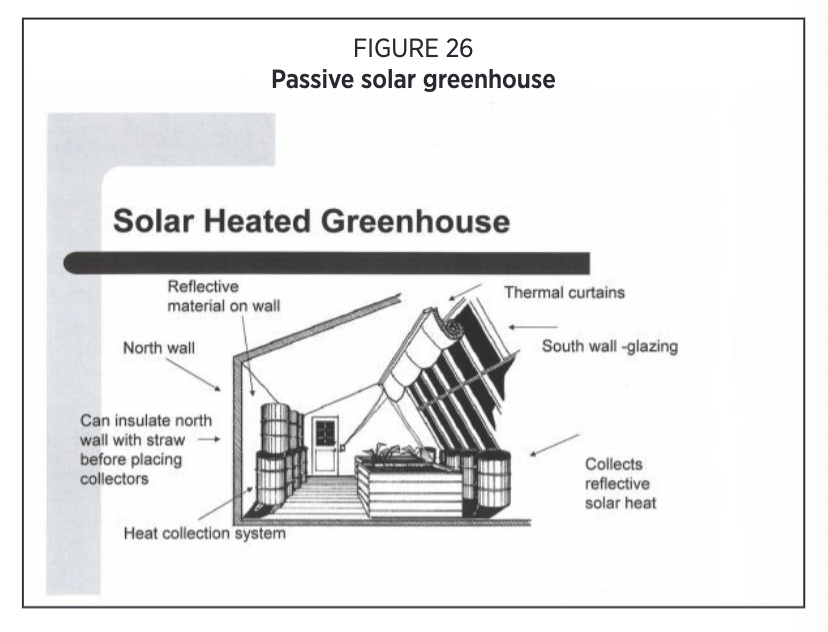
Heating: For small or backyard-size producers, implementing a passive heating system can help reduce heating costs during cold months. In this type of system, sunlight enters the south wall. The north wall has reflective material to trap and store heat. Black barrels filled with water absorb heat from sunlight during the day and slowly release the heat during the night. Thermal curtains can be hung on the south wall to trap heat during the night (Figure 26). While helpful to reduce heating costs, this practice would not be practical for large producers as it takes up valuable production space in the facility and is not able to maintain a consistent and reliable temperature.
Larger producers that have year-round, consistent production will need to maintain a temperature independent of what can be gained from the sun. Forced air heaters powered by natural gas, propane, or electricity are most commonly used in the U.S. These heaters control the air temperature by a thermostat. Radiant heaters such as wood or natural gas broilers control the temperature by pumping hot water through pipes located throughout the structure. Broilers are popular, as wood is a cheap source of fuel compared to oil or natural gas.
Cooling: The combination of manual and automatic ventilation is the most cost-effective way to cool down your greenhouse. Ventilation options include roll-up sides, ceiling vents, and vents along the long end of the greenhouse.
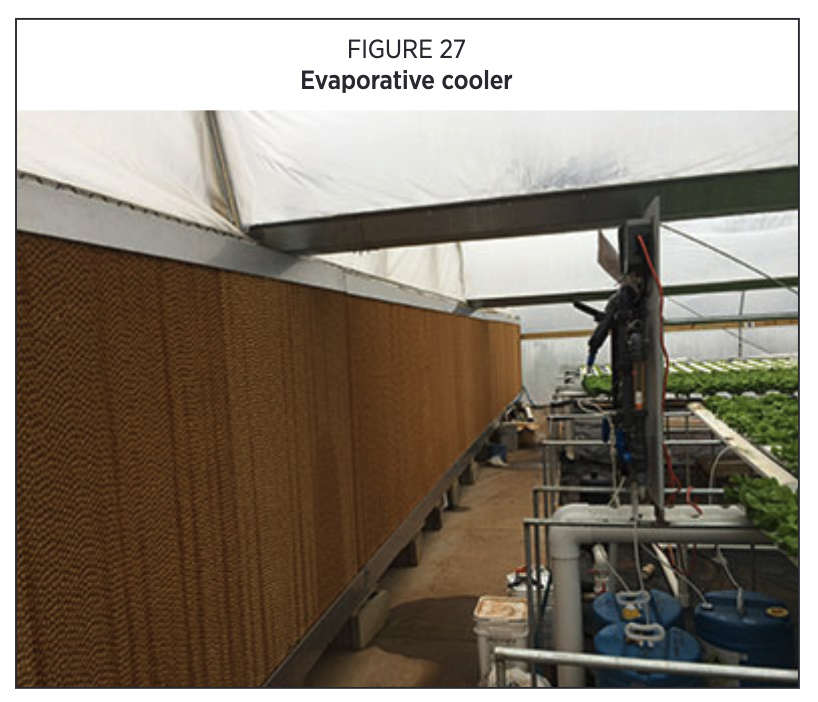
Forced air ventilation fans pull air through the length of greenhouse using thermostat-controlled vents at the opposite end. Evaporative coolers are a relatively inexpensive way to provide cooling to the structure in hot, dry climates. Evaporative coolers work by pulling in outside air through a wet wall, cooling the air as it comes in.
The wet wall is a frame that contains corrugated cardboard or synthetic material that is saturated by water dripping over its surface (Figure 27). Excess water is collected in a reservoir and pumped back over the cardboard. Evaporative cooling walls are not efficient in climates with high temperature and high humidity.
Source: Janelle Hager, Leigh Ann Bright, Josh Dusci, James Tidwell. 2021. Kentucky State University. Aquaponics Production Manual: A Practical Handbook for Growers.
9.4 Indoor Production
Original publication · First published on FarmHub Learn · Kentucky State University
Moving production into an insulated building is suitable for producers who want to be close to urban markets, have a lack of arable land, or live in a climate not suitable for outdoor or greenhouse production.
No matter where a plant is grown, it still requires optimal conditions to reach its maximum yield potential. In addition to the controls discussed above, producers must also provide light suitable for optimal plant growth. For plants, light stimulates seed germination, food production, flowering, chlorophyll manufacturing, and branch and leaf thickening.
Photosynthesis is stimulated by the type and frequency of light received. Light is emitted as waves of photons, or bundles of energy. The amount of energy in each photon determines the length of the wave from crest to crest. Lower energy wavelengths emit a blue light (400 nm) and higher energy wavelengths emit a red light (700 nm). Plants utilize wavelengths between 400-700 nm. Blue and red light is required in different ratios at different periods in the plant's life. Blue light is primarily responsible for vegetative growth. Red light triggers cell elongation, vegetative growth, and flowering.
Traditional plant grow lights are fluorescent (FL) or high intensity discharge (HID) fixtures. Compact T5, T8, and T12 FL bulbs are mainly used for seed propagation or vegetative growth. HID fixtures are often sold to accommodate both metal halide (MH) and high-pressure sodium (HPS) bulbs. Light produced by MH bulbs is the 400-550 range, suitable for vegetative growth. Light produced by HPS bulbs provide light in the yellow, orange, and red spectrum, more suited for flowering and fruiting stages. Both FL and HPS bulb have a lifespan of 20,000+ hours and generate a considerable amount of heat.
Advances in plant grow lights have made indoor production more cost effective through improved energy efficiency and higher plant yields. Induction fixtures (IND) are similar to FL bulbs but have become more popular, as they have no electrodes allowing them to last considerably longer (75,000+ hours). They also put off much less heat and are more energy efficient. Light emitting diodes (LED) lights were once too expensive for many growers; however, they are now considered the standard for plant grow lights. LED lights operate by passing an electrical current through two semi-conductors (one positive, one negative) which then emit light. The spectrum can be dialed into what is required by the plant at different stages, improving the quality and yield of the crop. In addition to improved energy efficiency, LED lights have a lifespan of 100,000+ hours.
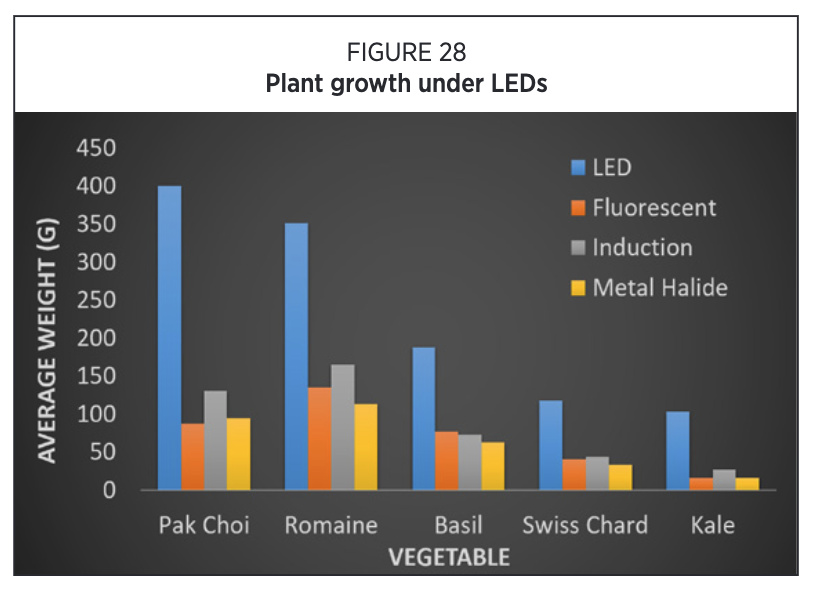
Research conducted at Kentucky State University compared growth of six leafy greens and energy use for FL, MH, IND, and LED grow lights. LED lights produced significantly higher plant biomass (g/m2) compared to the other three lights (Figure 28: KSU unpublished, Oliver et al. 2018). As the cost of LED lights continue to decrease, production costs for indoor plant production will also decrease.
Source: Janelle Hager, Leigh Ann Bright, Josh Dusci, James Tidwell. 2021. Kentucky State University. Aquaponics Production Manual: A Practical Handbook for Growers.
Kentucky State University — Janelle Hager, Leigh Anne Bright, Josh Dusci, and James Tidwell.
View the original source edition
Reformatted and consolidated from the original web edition.