Manual article / Aquaponics Production Manual
Plant Nutrient Dynamics
A sourced, attributed collection from its original edition.
On this page
Most plants can be described by five main structures: roots, stem, leaves, flowers, and fruits. Dissolved nutrients and water enter the plant via the roots through passive and active (requiring energy) transport. The xylem, located in the stem, is a one-way transport channel that moves water and minerals from the roots' hairs into the main body of the plant through capillary action. The stem is typically the primary support structure for leaves, buds, and other organs. The leaves are the powerhouse of the plant and use solar energy to convert carbon dioxide (CO2) and water into glucose (energy) and oxygen (the photosynthetic process). Glucose is transported to other parts of the plant via the phloem. Flowers and fruits are the reproductive organs of the plant. Flowers require fertilization to develop into fruits. This can be accomplished by wind, insects, birds, mammals, etc. In a greenhouse, flowers can be pollinated by fans' gently shaking the plant, causing it to release pollen grains, or manually using a Q-tip or soft paintbrush.
Like in soil, plants grown in aquaponics derive their nutrients and energy for growth and reproduction from photosynthesis, dissolved inorganic salts, and metabolites produced by bacteria and fungi. In aquaponics, the nutrients are derived from feeding fish. Plants have some ability to select the rate at which they absorb various ions. Just because the nutrient is provided in adequate quantities does not mean that the plant is absorbing it. Plants have 16 essential nutrients required for optimal health and growth (Table 8). Essential nutrients are those that cannot be synthesized by the organism and are classified by structural, macro-, and micro-, delineating how much is required by the plant. Nutrients can also be categorized by their mobility. Mobile nutrients are elements that can be transported throughout the plant (usually to new growth) as needed. Once immobile nutrients are deposited in the leaves (typically older or primary leaves), they are fixed and unable to be transported to other parts of the plant. This can benefit producers when signs of a nutrient deficiency are apparent by narrowing down the causative ions. Mobile nutrient deficiencies occur in older leaves whereas immobile nutrients occur in new growth of the plant. Three nutrients are not provided in adequate quantities in fish feed to support plant growth. These nutrients are calcium (Ca), potassium (K), and iron (Fe). As discussed above, CaCO3 and K2CO3 are used to both amend pH and provide essential nutrients. Iron is supplemented in the chelated form, which keeps it soluble in the water and prevents it from oxidizing in the system. Fe-DTPA is recommended because it is more stable at the pH suitable for aquaponics (6.0-7.5) and more cost effective than other forms.
Table 8: Sixteen essential nutrients required by plants for optimal health and growth. Circled elements represent limiting nutrients in aquaponics. Mobile nutrients are represented by (m) and immobile nutrients by (i).
| Essential Elements for Plant Growth | ||
| Structural | Macro | Micronutrients |
| Carbon (C) | Nitrogen (N)M | Iron (Fe)i |
| Hydrogen (H) | Phosphorous (P)M | Manganese (Mn) i |
| Oxygen (O) | Potassium (K)M | Boron (B)i |
| Calcium (Ca)i | Molybdenum (Mo)M | |
| Magnesium (Mg)M | Copper (Cu)i | |
| Sulfur (S)i | Zinc (Zn)i | |
| Chlorine (Cl)M | ||
Source: Janelle Hager, Leigh Ann Bright, Josh Dusci, James Tidwell. 2021. Kentucky State University. Aquaponics Production Manual: A Practical Handbook for Growers.
7.1 Providing and Measuring Plant Nutrients
Original publication · First published on FarmHub Learn · Kentucky State University
Nutrients enter the aquaponic system in the fish feed. The amount of nitrogen that is available to the plant is directly related to the protein content of the feed. The higher the protein content, the more nitrogen is available for plant growth. Unfortunately, high protein feeds are very expensive, so feeding a higher protein feed than your culture species requires is cost prohibitive. Nitrogen comes from the breakdown of proteins, whose structural components are made up of nitrogen-rich amino acids. Approximately 20% of the nitrogen and 50% of the phosphorous from the feed is utilized by the fish for growth. Much of the N and P (70% and 30%, respectively) is excreted as a waste product by the gills, and the remainder (10% and 20% for N and P, respectively) is excreted as particulate waste. Particulate waste, what we refer to in aquaponics as "solid," also contains macro- and micro-nutrients not absorbed by the fish. Utilizing this waste product can be accomplished through mineralization.
Table 9: Nutrient analysis of mineralized aquaponic system effluent after 14 days.
| Category | Day 0 | Day 14 | % change |
| pH | 6.54 | 6.48 | -1% |
| EC | 0.6 | 0.76 | 27% |
| MAJOR CATIONS (PPM) | |||
| Calcium(Ca) | 57.97 | 74.23 | 28% |
| Magnesium(Mg) | 13.31 | 17.54 | 32% |
| Potassium(K) | 27.38 | 32.65 | 19% |
| Sodium(NA) | 33.89 | 43.68 | 29% |
| Ammonium(NH4-N) | 0.79 | 0 | -79% |
| MAJOR ANIONS (PPM) | |||
| Nitrate(NO~3~-N) | 28.47 | 41.74 | 47% |
| Chloride(CI) | 46.76 | 62.61 | 34% |
| Fluoride(F) | 0 | 0 | 0% |
| Sulfate(SO4) | 53.29 | 58.92 | 11% |
| Phosphate(PO~4~) | 7.61 | 18.5 | 143% |
| Carbonates(CO3) | 0 | 0 | 0% |
| Bicarbonates(HCO3) | 19.81 | 22.21 | 12% |
| Alkalinity(mg) | 16.25 | 18.21 | 12% |
| TRACE (PPM) | |||
| Aluminum(AL) | 0.01 | 0.05 | 400% |
| Iron(Fe) | 1.95 | 1.95 | 0% |
| Manganese(Mn) | 0.001 | 0.03 | 290% |
| zinc(Zn) | 0.37 | 0.42 | 14% |
| Copper(Cu) | 0.02 | 0.08 | 300% |
| Boron(B) | 0.06 | 0.08 | 33% |
| Molybdenum(Mo) | 0 | 0 | 0% |
Mineralization of fish effluent functions similarly to processes in soil. In aquaponics, concentrated fish effluent is discharged into an offline holding tank. Microbes aerobically (or anaerobically) degrade organic solid materials, releasing soluble inorganic nutrients into the water, which are then available for plants to use (Delaide et al. 2018, Goddek et al. 2018). Nutrient-rich water can be accessed via the settling of particulate matter and siphoning water from the top.
Limited information exists on ideal environmental conditions necessary to achieve effective aerobic mineralization of fish effluent. Preliminary results from on-site aquaponic research systems at KSU show that mineralizing fish effluent for 14 days resulted in a 143% increase in phosphate (PO4), a 47% increase in nitrate (NO3-N), and ≥ 20% increase in calcium (Ca), magnesium (Mg), and potassium (K) compared to system water (Table 9). The particulate solids have an NPK ratio of 4:5:1, as well as notable levels of Ca and Mg.
Plant nutrients are quantified through laboratory testing of water and plant tissue. Testing can be rather expensive for farmers (typically between $20-$75 USD per sample) and results are not immediate. Some universities may provide free testing that can expedite the process and cut down on costs. Measuring the electrical conductivity (EC) of the water is helpful in determining the concentration of nutrient salts but does not quantify what nutrients are available to plants. The acceptable EC range for aquaponics is between 0.5-2.0 μS/cm.
Source: Janelle Hager, Leigh Ann Bright, Josh Dusci, James Tidwell. 2021. Kentucky State University. Aquaponics Production Manual: A Practical Handbook for Growers.
7.2 Common Nutrient Deficiencies
Original publication · First published on FarmHub Learn · Kentucky State University
A skill that is beneficial for aquaponics producers to keep in their toolbox is the ability to visually diagnose nutrient deficiencies. Once a plant exhibits symptom of a deficiency, severe stress is already occurring. Early detection and diagnosis are important.
Process of elimination can help growers successfully identify a nutrient deficiency. Key factors include recognizing where it occurs in the plant (mobile or immobile nutrient); taking note of the general appearance, such as color pattern or overall appearance; and eliminating other factors that may be causing the issue, such as light or heat damage. Below are common nutrient deficiencies that occur in aquaponics.
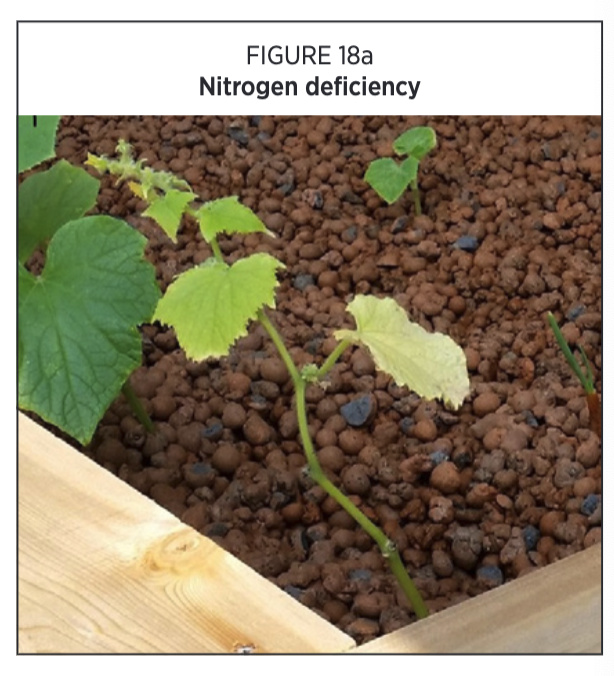
Nitrogen: Although not very common in aquaponic systems, nitrogen deficiencies most commonly occur when the fish culture units are undersized for the amount of plants in the system. Complete chlorosis (yellowing) of older leaves is the first sign and can spread to the whole plant if left untreated (Figure 18a). Other signs are slow or stunted growth and plants that look stretched. Nitrogen deficiency is typically not an issue in appropriately designed, well-cycled aquaponics systems.
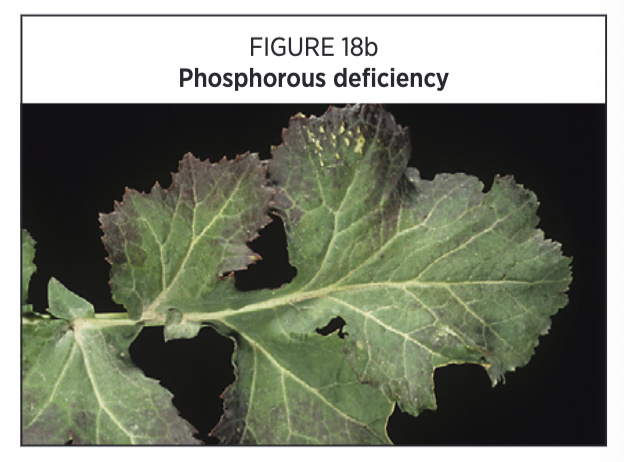
Phosphorous: Phosphorous deficiency in plants is characterized by dark green and/or purple coloration in older leaves (Figure 18b). It may also manifest at the tips and edges of the leaves, giving them a burnt look. Availability of P to plant is greatly reduced when pH is outside the range of 6.0-7.5 and when temperatures are ≤ 10^o^C (Islam et al. 2019). Symptoms are more noticeable in young plants, which have a greater relative demand for P than mature plants.
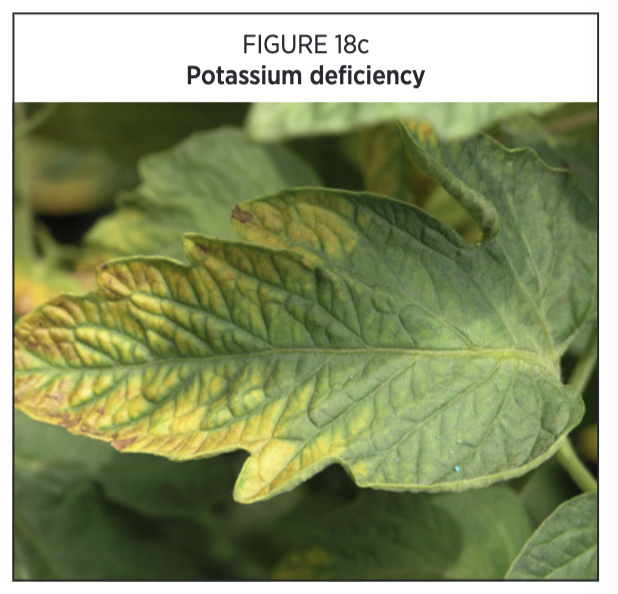
Potassium: Potassium deficiency does not immediately result in visible symptoms. Leaf margins will appear tanned, scorched, and/or have small black spots that later aggregate into necrotic region (Figure 18c). Margins of the leaves will cup downward, and growth will be restricted. Potassium is a key nutrient for proper flower and fruit development. Inadequate supply of K will result in flowers' dropping off the plant. High K concentrations can reduce the uptake of Ca by the plant. K is a limiting nutrient in aquaponics and must be supplemented to maintain levels required for plant growth.
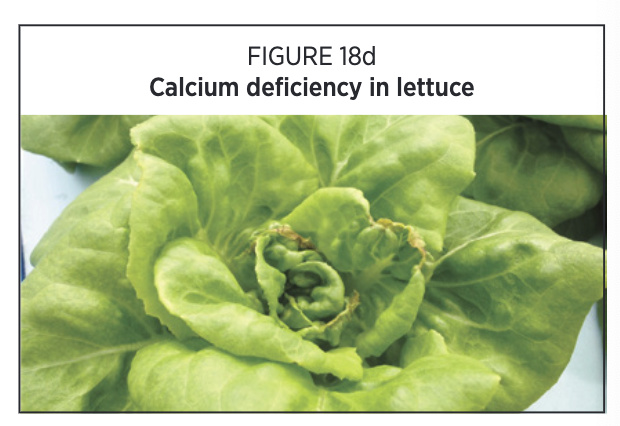
Calcium: Calcium is a limiting nutrient in aquaponics. Deficiencies will appear on new plant growth, as it is a mobile nutrient. Signs are small, deformed leaves that may exhibit scorched margins (tip burn) (Figure 18d). End blossom rot on tomato fruits is a characteristic sign of a Ca deficiency (Figure 18e). Even when adequate
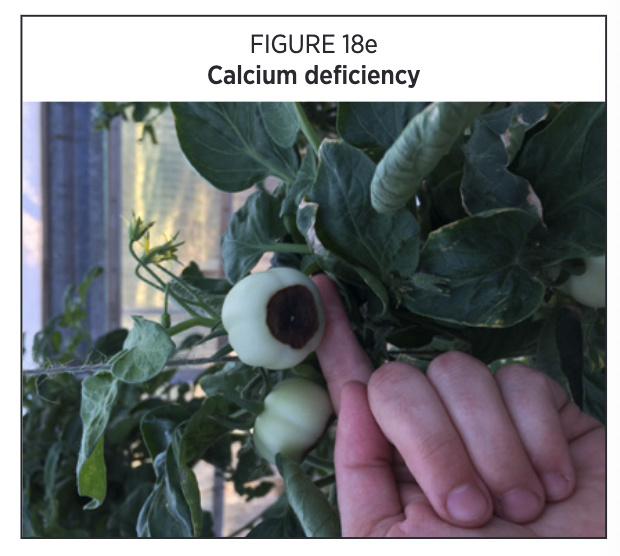
Ca is present, it is restricted from entering the plant in humid conditions and has antagonistic relationships with potassium (Somerville et al. 2014). In addition to CaCO3, crushed coral can be used to maintain Ca levels and increase alkalinity in aquaponic systems. Using crushed coral is anecdotal but has been effective in small and medium sized system. Using a source that is sanitized is critical as to not introduce foreign organisms or disease into the system
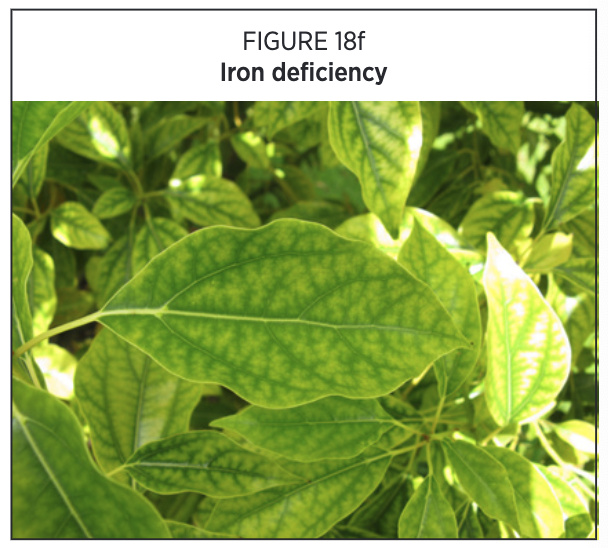
Iron: Iron is one of the more easily recognized deficiencies. Fe deficiency is characterized by chlorosis (yellowing) between the veins of the leaf (Figure 18f). The veins themselves will remain green. As Fe is an immobile nutrient, symptoms will appear on new leaves. Signs appear similar to a Mg deficiency but are easily differentiated, as Mg symptoms appear on older leaves (Mg is a mobile nutrient). Chelated Fe is added to the system to maintain Fe levels at 2 mg/L.
Source: Janelle Hager, Leigh Ann Bright, Josh Dusci, James Tidwell. 2021. Kentucky State University. Aquaponics Production Manual: A Practical Handbook for Growers.
Kentucky State University — Janelle Hager, Leigh Anne Bright, Josh Dusci, and James Tidwell.
View the original source edition
Reformatted and consolidated from the original web edition.