Manual article / Aquaponics Production Manual
Water Quality Parameters
A sourced, attributed collection from its original edition.
On this page
Understanding water chemistry in aquaponics is essential to providing optimal growth conditions for the fish, plants, and bacteria. By culturing fish in a recirculating system, all the essential elements for survival such as temperature, oxygen, pH, and water clarity need to be provided. Like all organisms, those cultured in aquaponic systems have optimum ranges for growth and survival. While there is overlap between optimum water quality ranges for each organism, a compromise must be made in many aspects of production (Table 6).
Table 6: Recommended water quality parameters for aquaponics*.
| Organism | Temperature (°C) | pH | Ammonia (mg/L) | Nitrite (mg/L) | Nitrate (mg/L) | DO(mg/L) |
| Warm water fish | 22 – 32 | 6 – 8.5 | < 3 | < 1 | < 400 | 4 – 6 |
| Cold water fish | 10 – 18 | 6 – 8.5 | < 1 | < 0.1 | < 400 | 6 – 8 |
| Plants | 16 – 30 | 5.5 – 7.5 | < 30 | < 1 | < 250 | > 3 |
| Bacteria | 14 – 34 | 6 – 8.5 | < 3 | < 1 | - | 4 – 8 |
| Compromise for Aquaponics | 18 – 30 | 6 – 7 | < 1 | < 1 | < 150 | 5 – 8 |
*Reproduced and adapted from FAO small-scale aquaponic food production (Somerville et al. 2014).
The five most important water chemistry parameters to consider for aquaponics are dissolved oxygen, temperature, pH, total ammonia nitrogen, and alkalinity.
- 6.1 Dissolved Oxygen
- 6.2 Temperature
- 6.3 pH
- 6.4 Total Ammonia-Nitrogen
- 6.5 Alkalinity
- 6.6 Cycling the System
- 6.7 Corrective Measures
Source: Janelle Hager, Leigh Ann Bright, Josh Dusci, James Tidwell. 2021. Kentucky State University. Aquaponics Production Manual: A Practical Handbook for Growers.
6.1 Dissolved Oxygen
Original publication · First published on FarmHub Learn · Kentucky State University
Oxygen is required at high levels by fish, plants, and bacteria. Oxygen content is quantified by the dissolved oxygen (DO) in water and is expressed as milligrams per liter (mg/L) (Somerville et al. 2014). The intensive nature of aquaponic systems requires oxygen supplementation. Oxygen can enter the system by agitation at the surface or by diffusers in the water column. Fish stocking density, number and type of plants, amount of organic solids, biological oxygen demand, and temperature are all factors that determine how much DO is needed (Rackocy et al. 2006, Wurts and Durborow 1992). DO and temperature have an important relationship. Oxygen is more soluble in cold water than it is in warm water, meaning that cold water can retain higher levels of dissolved oxygen than warm water. This is particularly important for producers raising warm water fish or operating in areas that experience high year-round or seasonal temperatures. It is recommended that dissolved oxygen be maintained between 5-8 mg/L. DO is difficult to measure, as meters can be expensive or hard to find. In this case, producers can purchase DO aquarium test kits or contact local Extension or universities for assistance.
Source: Janelle Hager, Leigh Ann Bright, Josh Dusci, James Tidwell. 2021. Kentucky State University. Aquaponics Production Manual: A Practical Handbook for Growers.
6.2 Temperature
Original publication · First published on FarmHub Learn · Kentucky State University
Water temperature is more important in aquaponics than air temperature. Many water chemistry factors are affected by temperature, such as the amount of toxic ammonia (un-ionized) present and the solubility of oxygen. It also directly impacts the health and survival of both fish and plants. Fish are poikilothermic, or cold-blooded. This means that their body temperature is dependent on water temperature. At extreme temperature, fish will stop eating, becoming lethargic and susceptible to disease. In plants, high temperature can reduce the uptake of essential plant nutrients, such as calcium, force early flowering in cool weather crops, and increase potential for plant roots pathogens like Pythium spp. For this reason, it is important to prevent wide swings in daily temperature. Shading or covering water surfaces, insulating fish tanks and plant beds, and utilizing passive or solar heating in greenhouses are strategies many producers employ. In temperate areas where temperature changes drastically from season to season, producers can alternate fish and plant crops seasonally to reduce heating or cooling costs.
Source: Janelle Hager, Leigh Ann Bright, Josh Dusci, James Tidwell. 2021. Kentucky State University. Aquaponics Production Manual: A Practical Handbook for Growers.
6.3 pH
Original publication · First published on FarmHub Learn · Kentucky State University
The pH is a measure of the acidity or basicity of a solution. It is determined by the presence or absence of free hydrogen ions (H^+^), where the more H^+^ present, the more acidic a solution is. An acidic solution has a low pH. The pH is measured on a scale from 1-14, with 7 being neutral. A pH value below 7 indicates a solution is acidic and above 7 indicates a solution is basic. The pH is recorded on a logarithmic scale and thus is not intuitive for many practitioners. For example, if the pH of an aquaponic system measures 7, then after two weeks measures 5, the pH has not dropped by a degree of 2, but rather 100 times. Understanding the pH scale is critical for water management and correction.
Fish, plants, and bacteria have specific tolerance ranges for pH. While they can tolerate parameters outside their optimal range, sub-par conditions can greatly affect growth and survival. Fish can tolerate a wide range of pH, from 6.0-8.5, but they need to be acclimated slowly to changes. The pH is particularly important for plants and bacteria. All micro- and macro-nutrients are available to plants at a pH between 6.0-6.5 (Figure 16). Above or below this range, certain nutrients are not available to the plants. When pH exceeds 7.5, plants quickly become deficient in essential nutrients like iron, phosphorous, and manganese (Somerville et al. 2014). Conversely, low pH can have negative impacts on nitrifying bacteria. Below 6.0, the ability to convert ammonia to nitrate is greatly reduced.
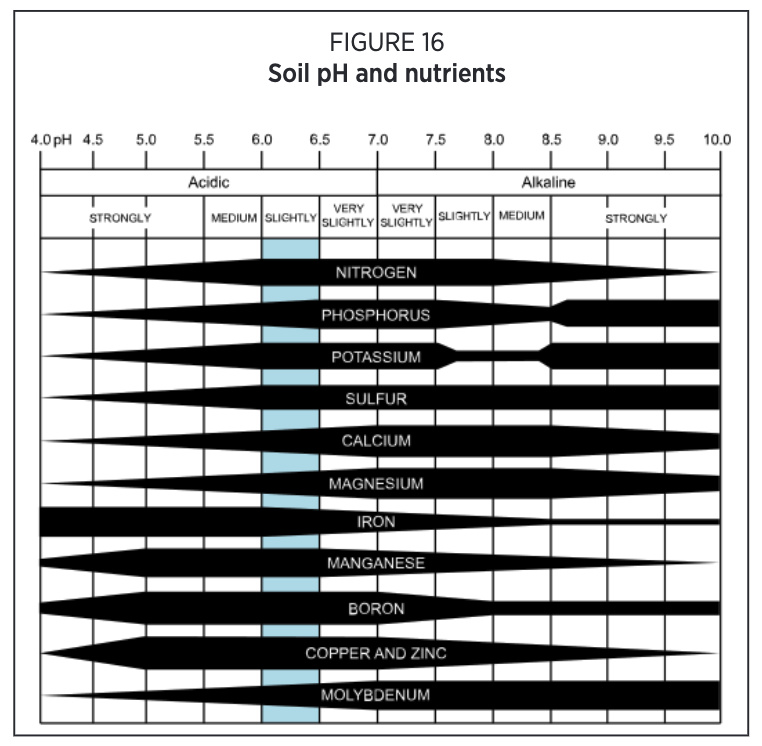
There are many factors that influence pH. Nitrification (discussed in the following section) and fish stocking density drive pH down by producing H^+^ and CO2, respectively. Amendments are needed to bring pH up to suitable culture levels. Managing pH begins with consistent monitoring and recording.
If pH is low, chemicals that increase total alkalinity, like calcium hydroxide (hydrated lime; Ca(OH)2), agricultural lime (calcium carbonate (CaCO3)), calcium potassium hydroxide (KOH), or potassium carbonate (K2CO3), can be used. The addition of calcium and potassium bases are alternated to provide essential nutrients not contained in fish food. Due to their high pH (10-11), these bases must be added with caution and in small doses, as to not raise the pH too quickly. Nitrification constantly drives pH down by depleting the water's total alkalinity and release of H^+^ ions, so consistent monitoring is important. The need to lower pH is typically not an issue for aquaponic producers, due to nitrification. Producers may need to amend their water source, however, by adding hard water or chemicals to increase alkalinity, which stabilizes or increases pH. If the pH of the system is constantly high, even after cycling, the first step is to make sure solids are not accumulating in the system. Solids that accumulate form anaerobic (low or no oxygen) zones. When anaerobic conditions develop, a process called denitrification, where nitrate is converted back into ammonia, occurs. Alkalinity is released during this transformation, which stabilizes the pH.
Source: Janelle Hager, Leigh Ann Bright, Josh Dusci, James Tidwell. 2021. Kentucky State University. Aquaponics Production Manual: A Practical Handbook for Growers.
6.4 Total Ammonia-Nitrogen
Original publication · First published on FarmHub Learn · Kentucky State University
Nitrogen enters the aquaponic system as crude protein in the fish feed. Approximately 30% of protein in the fish food is retained by the fish. Seventy percent is digested and released as solid waste or excreted as ammonia via the gills or as urea (Timmons and Ebeling 2013). Total ammonia nitrogen (TAN) is comprised of two forms that exist in a ratio of un-ionized ammonia (NH3, which is toxic to fish) to ionized ammonia (NH4+ which in non-toxic). The presence of one form over the other is dependent on pH and temperature. At high pH (basic) and temperature, there is a higher proportion of toxic ammonia. At low pH (acidic) and temperature, ammonia binds to excess H^+^ ions and becomes the less toxic form, ammonium. Generally, water quality tests will give the TAN value, which encompasses both NH3 and NH4+. The exact value of toxic ammonia can be determined by taking the number that intersects the recorded temperature and pH (Table 7) and multiplying it by the present TAN value (Masser et al. 1999).
Table 7: Fraction of total ammonia in the toxic (un-ionized) form at different pH values and temperatures.
| Temperature (oC) | |||||||||||||
| pH | 6 | 8 | 10 | 12 | 14 | 16 | 18 | 20 | 22 | 24 | 26 | 28 | 30 |
| 7.0 | .0013 | .0016 | .0018 | .0022 | .0025 | .0029 | .0034 | .0039 | .0046 | .0062 | .0060 | .0069 | .0080 |
| 7.2 | .0021 | .0025 | .0029 | .0034 | .0040 | .0046 | .0054 | .0062 | .0072 | .0083 | .0096 | .0110 | .0126 |
| 7.4 | .0034 | .0040 | .0046 | .0054 | .0063 | .0073 | .0085 | .0098 | .0114 | .0131 | .0150 | .0173 | .0198 |
| 7.6 | .0053 | .0063 | .0073 | .0086 | .0100 | .0116 | .0134 | .0155 | .0179 | .0206 | .0236 | .0271 | .0310 |
| 7.8 | .0084 | .0099 | .0116 | .0135 | .0157 | .0182 | .0211 | .0244 | .0281 | .0322 | .0370 | .0423 | .0482 |
| 8.0 | .0133 | .0156 | .0182 | .0212 | .0247 | .0286 | .0330 | .0381 | .0438 | .0502 | .0574 | .0654 | .0743 |
| 8.2 | .0210 | .0245 | .0286 | .0332 | .0385 | .0445 | .0514 | .0590 | .0676 | .0772 | .0880 | .0998 | .1129 |
| 8.4 | .0328 | .0383 | .0445 | .0517 | .0597 | .0688 | .0790 | .0904 | .1031 | .1171 | .1326 | .1495 | .1678 |
| 8.6 | .0510 | .0593 | .0688 | .0795 | .09114 | .1048 | .1197 | .1361 | .1541 | .1737 | .1950 | .2178 | .2422 |
| 8.8 | .0785 | .0909 | .1048 | .1204 | .1376 | .1566 | .1773 | .1998 | .2241 | .2500 | .2774 | .3062 | .3362 |
| 9.0 | .1190 | .1368 | .1565 | .1782 | .2018 | .2273 | .2546 | .2836 | .3140 | .3456 | .3783 | .4116 | .4453 |
| 9.2 | .1763 | .2008 | .2273 | .2558 | .2861 | .3180 | .5312 | .3855 | .4204 | .4557 | .4909 | .5258 | .5599 |
| 9.4 | .2533 | .2847 | .3180 | .3526 | .3884 | .4249 | .4618 | .4985 | .5348 | .5702 | .6045 | .6373 | .6685 |
| 9.6 | .3496 | .3868 | .4249 | .4633 | .5016 | .5394 | .5762 | .6117 | .6456 | .6777 | .7078 | .7358 | .7617 |
| 9.8 | .4600 | .5000 | .5394 | .5778 | .6147 | .6499 | .6831 | .7140 | .7428 | .7692 | .7933 | .8153 | .8351 |
| 10.0 | .5745 | .6131 | .6498 | .6844 | .7166 | .7463 | .7735 | .7983 | .8207 | .8408 | .8588 | .8749 | .8892 |
| 10.2 | .6815 | .7152 | .7463 | .7746 | .8003 | .8234 | .8441 | .8625 | .8788 | .8933 | .9060 | .9173 | .9271 |
Source: (Masser et al. 1999)
Through the process of nitrification, bacteria convert ammonia-nitrogen (NH3) to nitrite (NO2-) and then to nitrate (NO3-). Ammonia and nitrite are 100 times more toxic to fish than nitrate (Somerville et al. 2014). Plants primarily utilize nitrogen in the form of ammonium (NH4+), NO3- and amino acids such as L-glycine (Rentsch et al. 2007, Sanchez and Doerge 1999). In a fully functioning aquaponic system, ammonia and nitrite values should be close to zero and nitrate should be below 150mg/L. While fish can tolerate much higher levels, upward to 400 mg/L (Timmons and Ebeling 2013), values exceeding 250 mg/L can have negative impacts on plants (Rackocy et al. 2006). From a management perspective, it is important to know the tolerance range of fish and plant species to optimize growth conditions. At excessive levels, these toxic compounds can damage fish gills and stunt their growth.
Source: Janelle Hager, Leigh Ann Bright, Josh Dusci, James Tidwell. 2021. Kentucky State University. Aquaponics Production Manual: A Practical Handbook for Growers.
6.5 Alkalinity
Original publication · First published on FarmHub Learn · Kentucky State University
Alkalinity is an often-overlooked aspect of water quality but is essential in maintaining a stable system. Alkalinity is a measure of water's ability to buffer, or resist, changes in pH (Wurts and Durborow 1992). The most common forms of alkalinity are carbonates (CO3-) and bicarbonates (HCO3-). These carbonates bind to free H^+^ ions, a result of nitrification, preventing a drop in pH. Water with low alkalinity and a steady rate of nitrification experience wide swings in pH, which can be detrimental to the health of fish, plants, and bacteria. It is recommended to maintain alkalinity between 60-140 mg/L.
Alkalinity is often confused with water hardness. Hardness is determined by the quantity of positive ions, namely calcium (Ca2+) and magnesium (Mg2+) ions, present in the source water. Water from limestone bedrock has a high hardness (120-180 mg/L), while soft water has a low hardness (0-60 mg/L). Soft water is associated with rainwater or groundwater from volcanic bedrock. Water lacking appropriate hardness needs to receive amendments as Ca2+ and Mg2+ ions, which are essential for both plants and fish.
Alkalinity is not normally tested on a regular basis in aquaponics but is maintained through the addition of bases to raise pH. In addition to those listed above, non-chemical measures to increase alkalinity and pH include addition of finely crushed seashells, coarse limestone grit, and crushed chalk (Somerville et al. 2014). Placed in a mesh bag, they can be added to the sump until pH or alkalinity raises to the appropriate level. The size of your system will dictate how long these amendments will be effective and how often they will need to be replaced. Care must be taken to wash these items thoroughly to prevent contaminates from entering the system.
Source: Janelle Hager, Leigh Ann Bright, Josh Dusci, James Tidwell. 2021. Kentucky State University. Aquaponics Production Manual: A Practical Handbook for Growers.
6.6 Cycling the System
Original publication · First published on FarmHub Learn · Kentucky State University
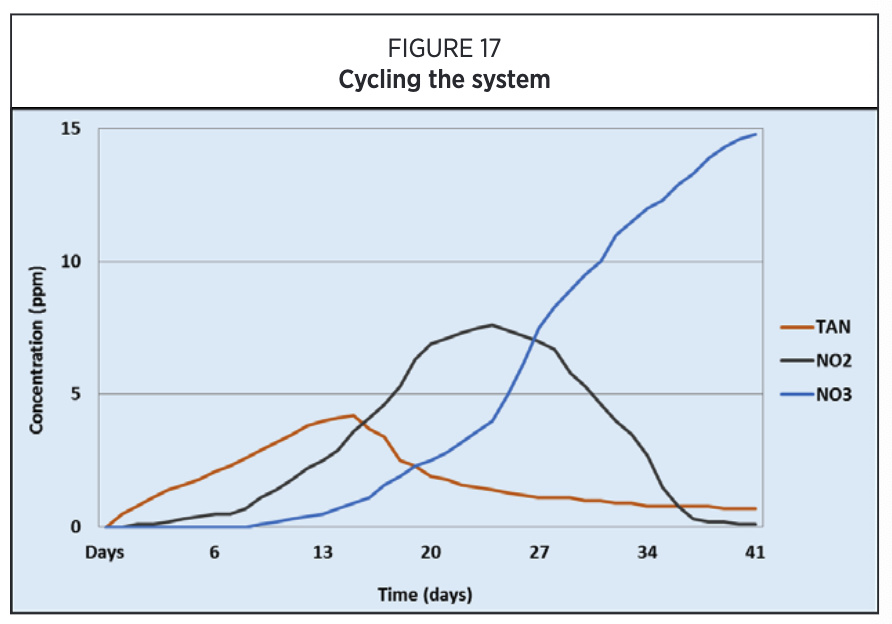
Cycling refers to the process of establishing the biological filter. This can take between six to eight weeks (Figure 17). Nitrifying bacteria are found naturally in the environment, so the process begins by adding a source of ammonia.
This can be accomplished through adding fish, fish food, or water from a well-established system, or a combination of these. One of the most common mistakes when using fish to cycle a system is adding too many fish initially. This causes ammonia levels to spike, often resulting in fish death. Starting with 20% of the total fish capacity is a good rule of thumb. This allows the appropriate, system-specific biological organisms to colonize. If using a fish-less cycling strategy, household ammonia can be used. It is important to source surfactant-free ammonia, as it lacks detergents commonly added to these products that are unsuitable for the system.
Source: Janelle Hager, Leigh Ann Bright, Josh Dusci, James Tidwell. 2021. Kentucky State University. Aquaponics Production Manual: A Practical Handbook for Growers.
6.7 Corrective Measures
Original publication · First published on FarmHub Learn · Kentucky State University
-
Low dissolved oxygen (below 5 mg/L): increase aeration, reduce feeding until corrected
-
Low pH (below 6.0): add base (calcium hydroxide, calcium carbonate, potassium hydroxide or potassium carbonate), reduce feeding until corrected
-
High ammonia (above 1 mg/L TAN): reduce feeding until corrected, perform 20% water exchange, check for accumulated solids, increase biological filtration
-
High nitrite (above 0.5 mg/L): reduce feeding until corrected, perform 20% water exchange, increase biological filtration
-
Consistently high nitrate: reduce fish biomass or feeding rate, add more plant biomass
-
Nitrate consistently at zero: increase fish feed or fish biomass
-
Low alkalinity: add carbonate bases ex. (calcium carbonate, potassium carbonate)
*Note: Adding any base to the system must be done with care. Small additions of these chemicals result in a large increase in pH. Base additions should be calculated before addition. Always err on the side of caution.
Source: Janelle Hager, Leigh Ann Bright, Josh Dusci, James Tidwell. 2021. Kentucky State University. Aquaponics Production Manual: A Practical Handbook for Growers.
Kentucky State University — Janelle Hager, Leigh Anne Bright, Josh Dusci, and James Tidwell.
View the original source edition
Reformatted and consolidated from the original web edition.