Manual article / Aquaponics Production Manual
System Technology
A sourced, attributed collection from its original edition.
On this page
Source: Janelle Hager, Leigh Ann Bright, Josh Dusci, James Tidwell. 2021. Kentucky State University. Aquaponics Production Manual: A Practical Handbook for Growers.
3.1 Water Sources
Original publication · First published on FarmHub Learn · Kentucky State University
Sourcing water is an important consideration, as it directly impacts system management and performance. Typically, 1-3% of total system water is replaced per day depending on climate, time of year, and crops being produced (Somerville et al. 2014). Water is lost in the system through evaporation, transpiration into the plant, and through normal processes of splashing, cleaning, and harvesting.
Water with a salinity above 0.8 parts per thousand (ppt) are typically not suitable for aquaponic production as the majority of cultured plants do not tolerate even a small degree of salt (Shannon and Grieve 1998). Common aquaponic crops with a salinity tolerance include lettuce (0.83 -- 2.8 ppt), kale (up to 7.4 ppt), Swiss chard (1.5 -- 3.5 ppt), and tomatoes (up to 5.8 ppt) (Maggio et al. 2007, Shannon and Grieve 1998, Shannon et al. 2000). Even though some crops do show an ability to tolerate salt, growth is compromised at some point during production..
The majority of aquaponic producers utilize rainwater, well water, municipal water or a combination for their systems.
Rainwater: Rainwater typically has a neutral or slightly acidic pH, slight calcium and magnesium hardness, and no salinity (Somerville et al. 2014). In large systems, rainwater is generally best utilized in conjunction with other sources to reduce overhead cost and improve sustainability.
Rainwater run-off can easily be captured from roofs or gutters and stored for later use. Water collected from roofs should be treated prior to use, as they may contain bacteria and pathogens from bird or rodent droppings. Considerations include areas that may receive acid rain, laws that prohibit collection, and roof material and age. Some research has suggested that new and aging roofs are not suitable for collection (Clark et al. 2008), as materials such as shingles, cedar, and uncoated galvanized aluminum can contaminate water with chemicals, heavy metals, and pollutants.
Well water: Well water is a viable option for some producers. Considerations include potential contaminants and bedrock composition. Chemicals that are particularly harmful include heavy metals, iron, and sulfur. Aquifers with bedrock composed of limestone have high water hardness and alkalinity concentrations. Alkalinity (bases in the water like carbonates, bicarbonates, and hydroxides) prevents swings in pH, which is naturally lowered in aquaponics from nitrification. Alternately, producers with very low fish production may require water treatment to decrease hardness and/or alkalinity before use (Somerville et al. 2014). Lack of fish and subsequent feed input can cause pH to remain too high, making certain nutrients inaccessible to the plant. Pumping rate of the aquifer will also need to be determined if it will be the only source of water for an aquaponic system. This is particularly important in systems that will require large water additions or replacement.
Municipal water: Municipal water is ideal for use in aquaponic systems. Chlorine in tap water eliminates bacteria, pathogens, and algae, making it a safe and reliable source of water. Chlorine and chloramines, however, must be removed before use as it is toxic to fish and will kill off the nitrifying bacteria.
Chloramine is basically a very stable molecule of chlorine bound to ammonia. Unlike chlorine alone, chloramines cannot evaporate out of the water. This provides rural households with a safe supply of drinking water but makes its use tricky for aquaponic producers. Free chlorine in the water can be gassed off in 48-72 hours with aeration. Chloramines require chemical dissipation (ex. sodium thiosulfate) or charcoal filtration. Given the small volume of water exchange, chloramines typically do not negatively impact an aquaponic system. Typically, you can replace around 10% of the system water volume without treating or testing for chlorine/chloramines.
Surface water: Surface water includes ponds, lakes, rivers, and streams. Surface water can introduce pathogens, algae, snails, and other organisms. In addition, many surface waters are contaminated with pollutants or agricultural run-off that pose a food safety threat to the organisms in the system and to consumers.
Source: Janelle Hager, Leigh Ann Bright, Josh Dusci, James Tidwell. 2021. Kentucky State University. Aquaponics Production Manual: A Practical Handbook for Growers.
3.2 Disposal of Waste
Original publication · First published on FarmHub Learn · Kentucky State University
Recovery and digestion of fish effluent is more important in aquaponics than waste disposal. A large portion of feed is excreted as solid waste. Nutrients essential for plant growth are trapped within this concentrated slurry and should be recovered to reduce production costs and limit the need for nutrient supplementation. Recovery of these nutrients moves aquaponic production towards a zero-discharge system. Nutrients can be recovered through aerobic or anaerobic digestion of solids. Direct application of nutrients to crop land or composting sludge may be appropriate.
Mineralization: Approximately 20% of the N and 50% of the P from the feed is utilized by the fish for their growth (Timmons et al. 2018). The remainder of the N and P (70% and 30%, respectively) is excreted as a waste product by the gills and as particulate waste (10% and 20% for N and P, respectively). Particulate waste also contains macro- and micro- nutrients not absorbed by the fish. Recovery of these nutrients can improve plant growth and limit the need for supplemental nutrients.
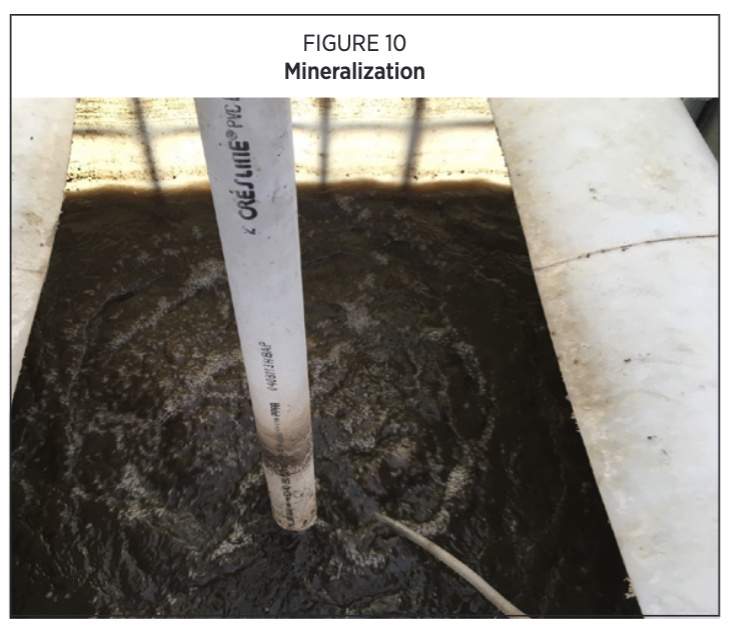
Mineralization of fish effluent functions similarly to the processes that occur in soil. In AP, concentrated fish effluent is discharged into an offline holding tank. Microbes aerobically (or anaerobically) degrade organic solid materials, releasing soluble inorganic nutrients into the water, which are then available for plants to use (Delaide et al. 2018, Goddek et al. 2018). Only in an inorganic form are nutrients available to plants. Under aerobic conditions, heavy aeration is applied to concentrated solids (Figure 10). After 8-10 days, aeration is turned off, solids are allowed to settle, and clarified water is released into the system (Pattillo 2017). Under anaerobic conditions, bacteria decompose organic matter in environments with little to no oxygen. Anaerobic digestion produces methane gas (CH4) that can be utilized as biofuel (Dana 2010) and concentrated digestant that can be applied to greenhouse crops (Pickens 2015) or used for seedling production (Danaher et al. 2009, Pantanella et al. 2011). Anaerobic digestion of fish solids is more complex to manage than aerobic digestion and may be cost prohibitive due to the large digester volume needed (Chen et al. 1997).
Limited information exists on microbial contribution or environmental processes that underlay effective aerobic mineralization of fish effluent; however, studies suggest that nutrient recovery from fish solids can be significant (Cerozi and Fitzsimmons 2017, Cerozi and Fitzsimmons 2016, Goddek et al. 2018, Rakocy et al. 2016, Tyson et al. 2011, Yogev et al. 2016, Khiari et al. 2019, Graber and Junge 2009). Preliminary results from on-site AP research systems at Kentucky State University (KSU) show that aerobic mineralization of fish effluent for 14 days resulted in a 143% increase (7.61 to 18.5 mg/L) in phosphate (PO4), a 47% increase in nitrate (NO3-N; 28.5 to 41.7 mg/L), and ≥ 20% increase in Ca (57.97 to 74.23 mg/L) and K (27.38 to 32.7 mg/L) compared to system water (unpublished). However, even if nutrients are recovered from effluent and provided in the right form and quantity, interactions with other nutrients and water chemistry can sometimes make them unavailable to plants (Bryson and Mills 2014).
Direct application: Waste can also be applied directly as a soil amendment, composted through traditional heat-treatment methods, or via vermicompost (worm composting). Direct application should be used as a low-grade fertilizer or if the slurry is less than one percent solids. Heat-based composting of dewatered fish solids requires additional expertise and labor cost but can add an important additional income stream. Vermicomposting uses similar methods to traditional composting but does not rely on heat to process waste. Worms consume organic matter, fragment and aerate the solid material, and can potentially provide a supplemental live feed for fish (Yeo and Binkowski 2010). Compost can include vegetable waste or other compostable materials from production. It is not uncommon for mineralized effluent to be bottled and sold directly to home gardeners or small greenhouse operations; however, some restrictions may apply depending on your local regulations.
Source: Janelle Hager, Leigh Ann Bright, Josh Dusci, James Tidwell. 2021. Kentucky State University. Aquaponics Production Manual: A Practical Handbook for Growers.
Kentucky State University — Janelle Hager, Leigh Anne Bright, Josh Dusci, and James Tidwell.
View the original source edition
Reformatted and consolidated from the original web edition.