Manual article / Aquaponics Production Manual
Structure and Design
A sourced, attributed collection from its original edition.
On this page
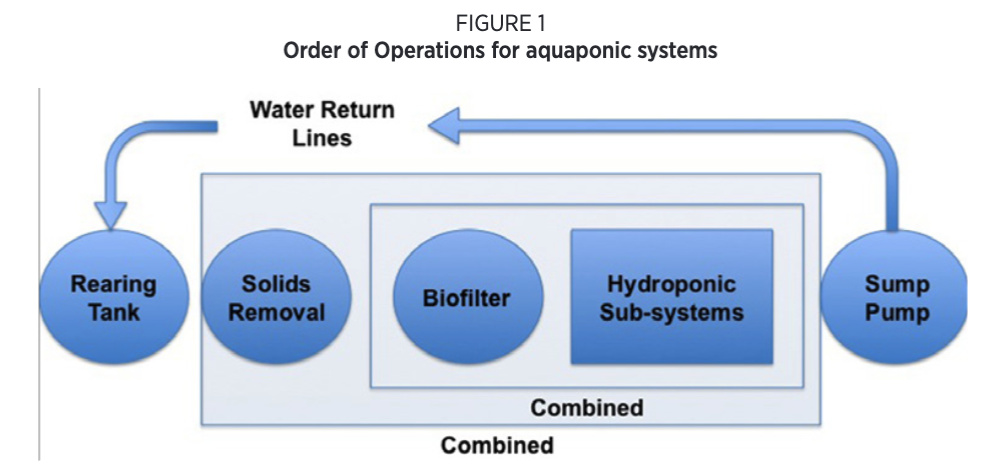
The majority of aquaponic systems follow the same basic design or "order of operations" (Figure 1). The main components of aquaponic systems are a fish culture tank, solids filtration, biological filtration, hydroponic component, and sump. The solids and biological filtration can either be combined (ex. media- based system) or separated into different units (ex. deep water culture).
- 2.1 Fish Culture
- 2.2 Solids Filtration
- 2.3 Biological Filtration
- 2.4 Plant Culture or Hydroponic Subsystem
- 2.5 Sump
Source: Janelle Hager, Leigh Ann Bright, Josh Dusci, James Tidwell. 2021. Kentucky State University. Aquaponics Production Manual: A Practical Handbook for Growers.
2.1 Fish Culture
Original publication · First published on FarmHub Learn · Kentucky State University
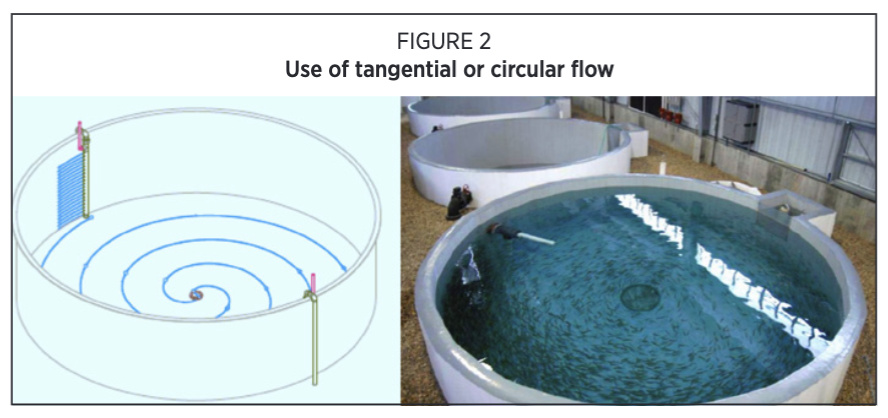
Fish tanks for aquaponics come in a wide range of shapes, sizes, and materials, with selection being largely based on culture species. The majority of large systems use round tanks that either have a flat- or cone-bottom. Use of tangential flow will prevent dead zones when used in round tanks (Figure 2). Cone-bottom tanks allow solids to concentrate at the bottom (in the cone) and be easily flushed from the system. Flat-bottom tanks are more widely available, but solids removal requires additional steps to ensure proper removal of organic material dispersed across the bottom of the tank.
Square tanks may also require additional cleaning as solids or debris can settle in corners (Somerville et al. 2014). Sizing for fish culture tanks follow RAS principles, with a 3:1 width to height ratio being ideal for proper water movement and flow. Fish tanks are generally the highest point of the system and water flows via gravity to the solids filtration component.
Commercial-grade tanks are commonly made from strong, UV-stable materials like high-density polyethylene (HDPE) plastic or fiberglass. On a smaller scale or in areas with limited resources, intermediate bulk containers (IBC) or lined cement troughs may be utilized. Food-grade and UV resistant materials are necessary as many repurposed tanks may have held chemicals or hazardous materials, making them unsuitable fish intended for consumption.
Source: Janelle Hager, Leigh Ann Bright, Josh Dusci, James Tidwell. 2021. Kentucky State University. Aquaponics Production Manual: A Practical Handbook for Growers.
2.2 Solids Filtration
Original publication · First published on FarmHub Learn · Kentucky State University
Effective solids filtration is a key component to a well-functioning system and potentially the most important aspect as it influences the efficiency of all other processes. Solids are mostly produced from uneaten feed, fish waste, and bacteria biofilms (classified as suspended solids) (Timmons and Ebeling 2013). If waste is not removed, it can settle on plant roots (preventing uptake of nutrients), collect in areas of low water flow (resulting in poor water quality), cause the build-up of noxious gas, and clog pipes (preventing sufficient water flow) (Somerville et al. 2014).
The solids filtration utilized depends on the quality and quantity of feed entering the system, with all designs coming directly from RAS technology. The two main categories of solids filtration are sedimentation and mechanical filtration (Lennard 2012).
Sedimentation: Sedimentation refers to solids settling from the water column via gravity, which occurs in the clarifier. Clarifier, or (solids removal) designs include baffles, radial flow filters, and swirl separators (Figure 3a, b, c). Radial flow separators are most commonly used and have been shown to be more effective at removing settleable solids than a swirl filter in RAS (Davidson and Summerfelt 2005). Baffle and swirl clarifiers are similar in solids removal efficiency (Danaher et al. 2013). Recommendations for construction material follow that of fish tanks mentioned above.
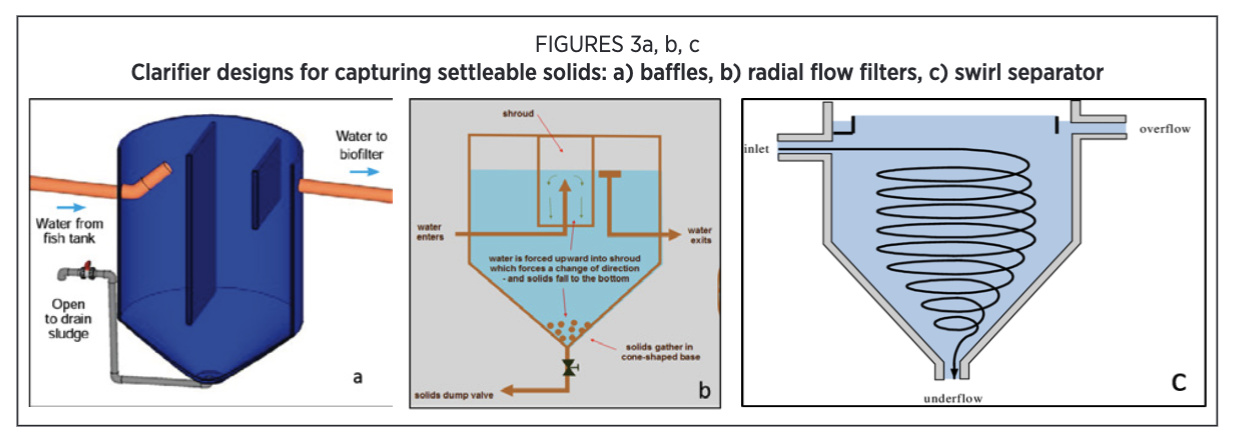
Proper sizing of clarifiers and appropriate water flow rate are essential for effective solids removal. If relying solely on a clarifier to remove settleable solids, a 30-minute retention time is required. This simply means that most solids that can settle via gravity will do so within 30 minutes. A water flow rate of 5 gallons per minute for small tanks and 25 gallons per minute for large tanks should be used to calculate the size of the filtration tank needed. Filtration that is under-sized (or a flow rate that is too fast) will not be adequate to remove fish solids, resulting in accumulation further down in the system. Likewise, oversizing the component is not ideal as it increases the upfront cost, requires a larger footprint in the facility, and results in a greater amount of water use through inefficient discharge.
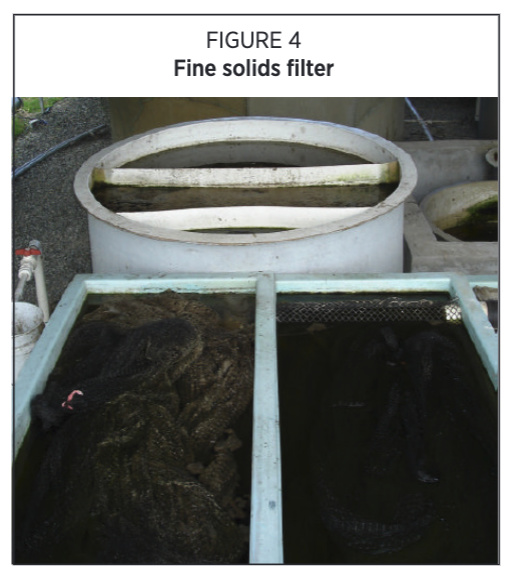
Clarifiers will only remove the large solid particles in the water, leaving solids that are too small to settle out of the water (Summerfelt et al. 2001). These suspended solids must be removed. A practice made popular by the University of the Virgin Islands is directing water from the clarifier through tanks filled with orchard netting (Figure 4). Netting material traps fine solids, allowing clean water to be skimmed from the surface. Other options for removing suspended solids are fine mesh bags, women's stockings, filter pads, and others. These items may quickly become clogged if settleable solids are not effectively removed in the clarifiers.
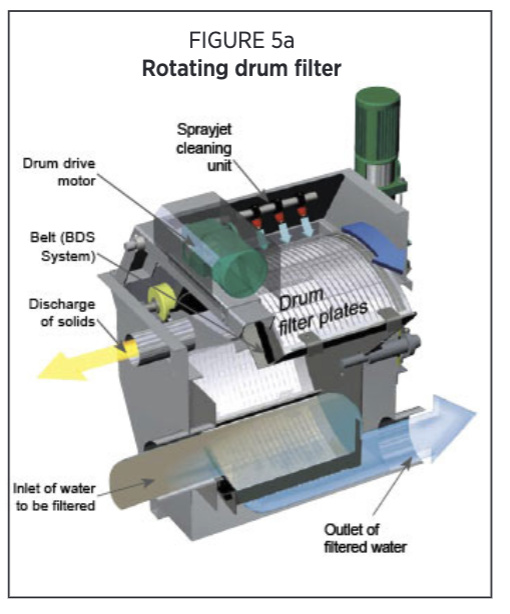
Mechanical Separation: Mechanical separation is the active removal of solids via a screen or media (Lennard 2012).
These filters are extremely efficient, removing solids larger than 50 microns, resulting in less time spent on cleaning and maintenance due to their convenient automatic backwash feature. Examples of these filters include drum filter (Figure 5a) and a pressurized bead filter (Figure 5b).
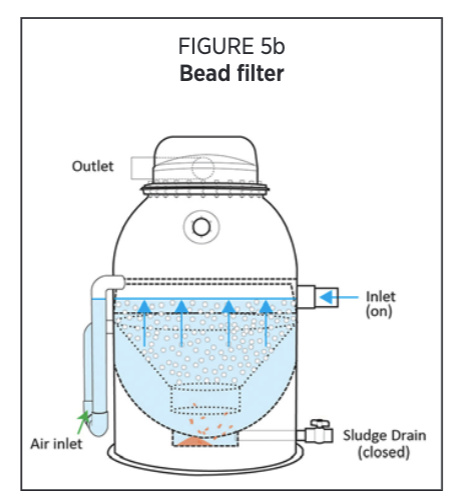
Mechanical filters have a high price tag, often making them prohibitive for small-scale practitioners. In addition, they require more advanced knowledge to operate and are difficult to obtain in developing countries. This type of filtration would be appropriate for a large, decoupled aquaponic system or those that focus the majority of their operation on fish production.
Source: Janelle Hager, Leigh Ann Bright, Josh Dusci, James Tidwell. 2021. Kentucky State University. Aquaponics Production Manual: A Practical Handbook for Growers.
2.3 Biological Filtration
Original publication · First published on FarmHub Learn · Kentucky State University
Biological filtration refers to the breakdown of ammonia (NH3 and NH4+) into nitrite (NO2) and then further into nitrate (NO3) by naturally occurring, nitrifying bacteria. These bacteria live on the surface area of media contained in a tank
collectively called the biofilter. The process of converting ammonia to nitrate will be detailed in the section on water quality.
In RAS, the biofilter is designed to operate at low pressure. There is a dedicated tank filled with substrate like Kaldnes media, granular media, plastic balls, or other inert materials that have a large specific surface area or surface area of the media per unit volume. The higher the specific surface area, the more bacteria can grow on the media, translating to a higher ammonia removal capacity. Typical biofilter designs for RAS include trickle towers, submerged media, fluidized beds, sand filters, and static bed filter. In aquaponics, the biofilter can either be a separate unit or part of the system. In deep water culture (DWC), the plant trough walls, raft bottoms, and plant roots provide a significant surface area for nitrifying bacteria to colonize. Unlike RAS, the AP system itself typically provides ample surface area for bacteria to colonize, particularly for coupled systems that are appropriately sized. The nutrient film technique (NFT) system (see section below) is an exception, as only a thin layer of water is applied to the plants. If the biofilter is a separate unit, it should be located after the solids removal unit.
Source: Janelle Hager, Leigh Ann Bright, Josh Dusci, James Tidwell. 2021. Kentucky State University. Aquaponics Production Manual: A Practical Handbook for Growers.
2.4 Plant Culture or Hydroponic Subsystem
Original publication · First published on FarmHub Learn · Kentucky State University
The hydroponic portion of the system encompasses the majority of the facility footprint. Three primary designs are used: media beds, deep water culture (DWC), and NFT.
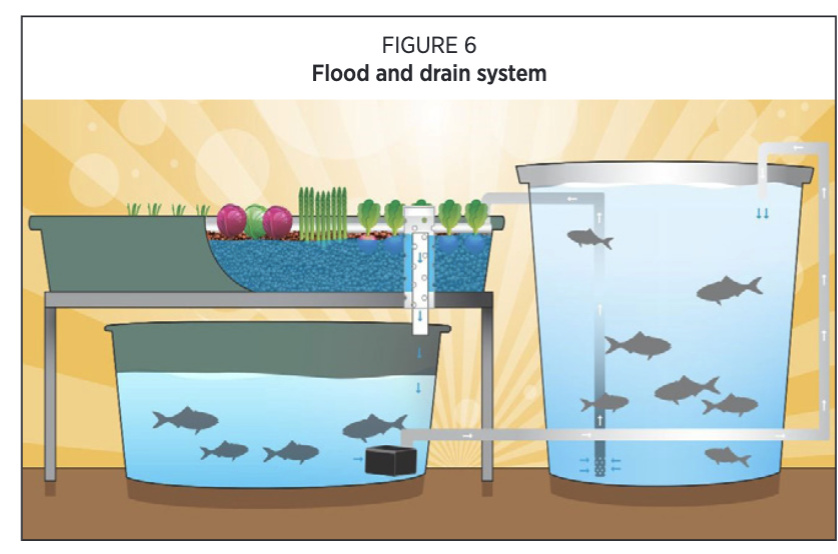
Media-based systems: The design of media-based systems, sometimes called flood-and- drain, is fairly straight forward. A container filled with substrate is periodically flooded with water from the fish tank. Water then drains back to the sump (or fish tank) drawing oxygen into the substrate for plant roots and nitrifying bacteria. The media bed supports the plant as it grows and serves as a solids and biological filter (Figure 6). Due to relatively few components and ease of construction and operation, these systems are popular for hobbyists and in developing regions. However, it is uncommon to find commercial production using only media beds as they are less productive than other types discussed below. Rule of Thumb for media systems are detailed in Table 1.
Table 1: Rules of thumb for media-based aquaponic systems.
| Rules of Thumb for Media-Based Aquaponic Systems | |
| Substrate Characteristics |
|
| System Design |
|
| Carrying Capacity |
|
| Water Flow Management |
|
| Maintenance |
|
A variety of materials can be used as substrate, including pea gravel, lava rock, expanded clay pebbles, or other inert media; practitioners may be limited by what is locally available. Water flow in the system is controlled by either a timer or siphon. Using the timer method, water is pumped for a set amount of time, allowing the bed to fill.
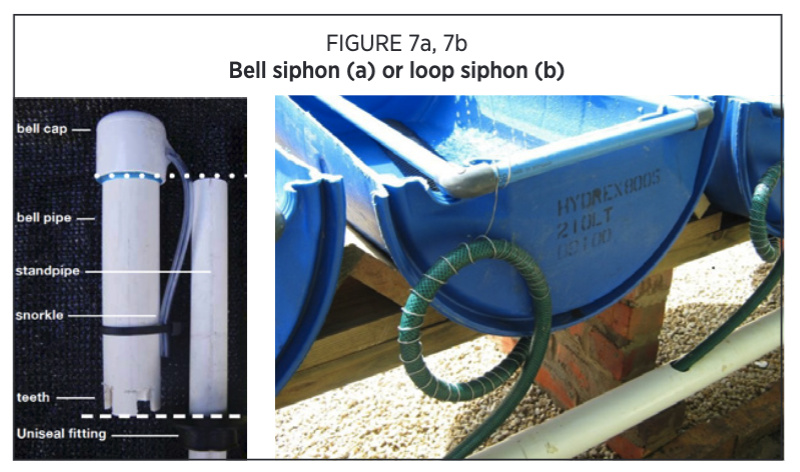
When the timer shuts off, water drains until the timer engages the pump again. The siphon method is often implemented using an automatic bell siphon (Figure 7a) or loop siphon (Figure 7b). In both siphon methods, the pump runs continuously, controlling how fast the bed fills and drains. Fox et al. (2010) gives comprehensive, step-by- step instructions for building, operating, and troubleshooting an automatic bell siphon.
Constant-flow media systems offer an alternative to the flood-and-drain method. Heavily aerated water flows into the media bed. Instead of a flood- and-drain cycle, the water level stays constant by using a standpipe. This drastically reduces the size of the sump needed for this type of growing system.
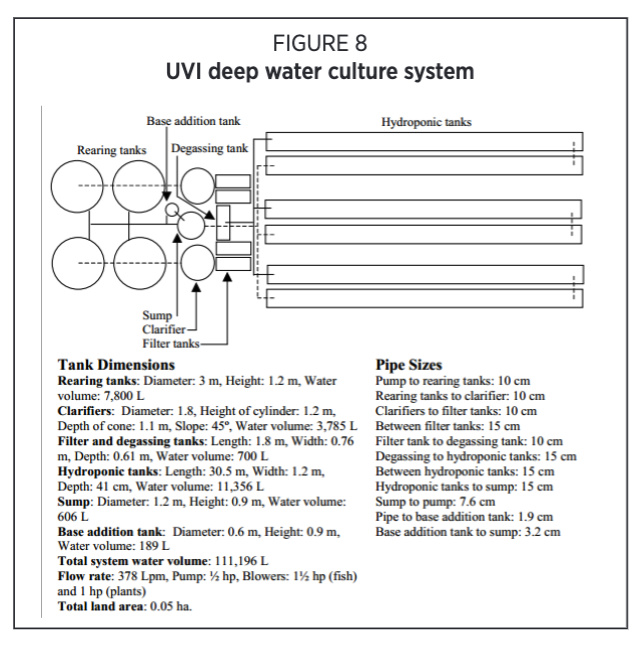
Deep Water Culture: This growing method involves suspending plants in a floating raft, allowing the roots to hang down into the water (Figure 8). Plant roots are in constant contact with nutrient-rich water from the fish tank.
Effective solids filtration is a requirement in these systems to prevent solids from entering the plant bed and clogging plant roots. Aeration must also be provided in the plant troughs to maintain adequate oxygen levels for plant roots and beneficial bacteria. Along with their large water holding capacity that keeps water quality parameters more stable, the underside of the rafts and lining of the troughs provide adequate space for nitrifying bacteria to colonize. The design itself also provides a cushion against power outages, as roots stay submerged in water despite loss of water or air flow.
Table 2: Rules of thumb for DWC in aquaponics.
| Rules of Thumb for Deep Water Culture in Aquaponics | |
| Substrate Characteristics |
|
| System Design |
|
| Carrying Capacity |
|
| Water Flow Management |
|
| Maintenance |
|
*Exception is in early life stages where fish can consume 5-10% of their body weight in food per day.
Deep water culture (DWC) is more productive (kg of produce/m^2^ growing space) than media-based systems; however, it can be more difficult to manage on a smaller scale. These systems are well researched by the hydroponics and aquaponics industry and are commonly implemented in commercial settings.
Leafy greens and herbs, such as basil, do well in this production system. Fruiting crops like tomatoes, cucumbers, and peppers can be successful with appropriate nutrient densities and structural support. The DWC technique may not be suitable for areas where access to supplies or equipment is limited. Rules of thumb for DWC in aquaponics are listed in Table 2.
Nutrient Film Technique: Nutrient Film Technique (NFT) technology comes directly from the hydroponics industry. In this method, plants are inserted into the top of shallow horizontal channels. A small film of water is pumped through the channel, coming into contact with plant roots that utilize those nutrients for growth (Figure 9). NFT systems, like DWC, require sufficient solids filtration to prevent contamination of plant roots. In contrast to DWC, NFT systems need a separate biological filter, as the channel alone does not provide enough surface area for sufficient growth of nitrifying bacteria.
These systems are more complex to design, build, and manage than media-based systems. If channels are not sized correctly, plant roots can disrupt water flow by clogging the pipes. This design assumes a degree of risk, as pump failure can result in large crop loss if water flow does not resume quickly. However, NFT can be a great system for urban areas or rooftops as they are lightweight, use very little water, and can be made from easily sourced materials. Rules of thumb for NFT in aquaponics are listed in Table 3.
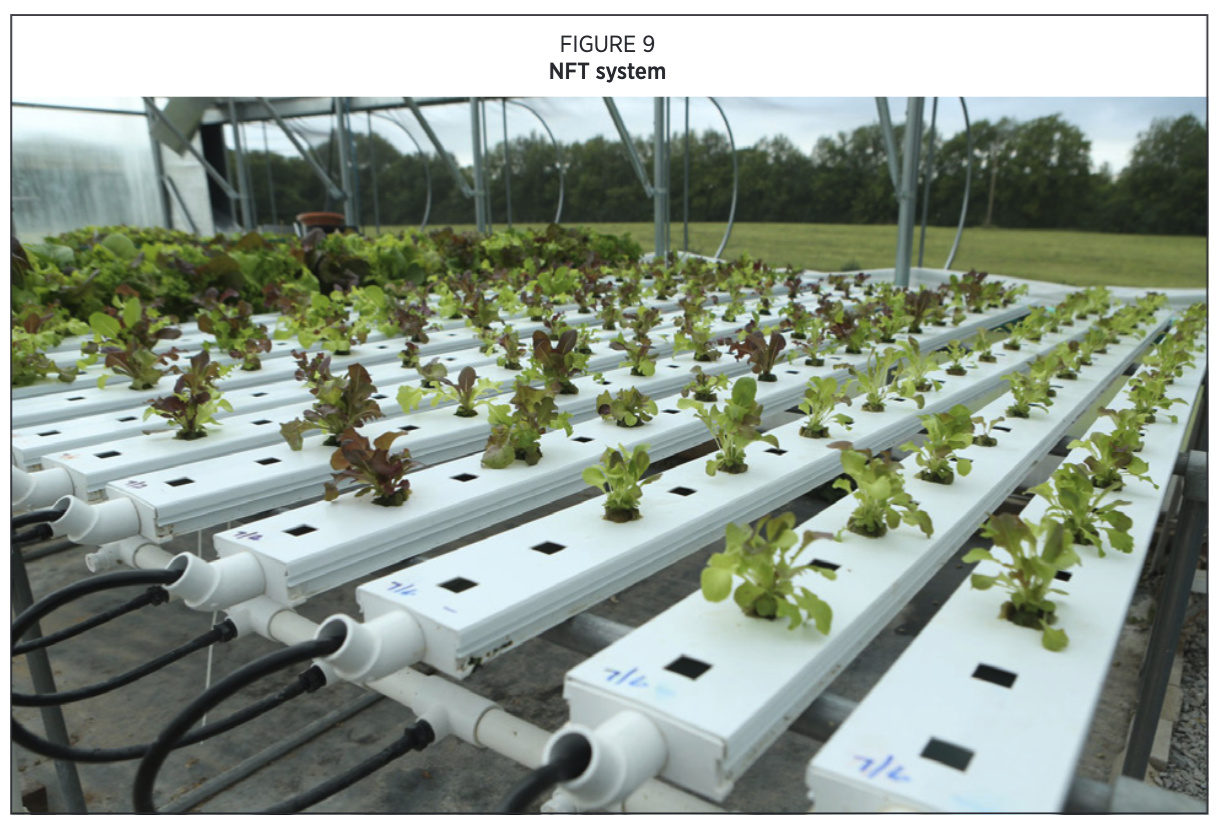
Table 3: Rules of thumb for NFT in aquaponics
| Rules of Thumb for Nutrient Film Technique in Aquaponics | |
| Substrate Characteristics |
|
| System Design |
|
| Carrying Capacity |
|
| Water Flow Management |
|
| Maintenance |
|
*Exception is in early life stages where fish can consume 5-10% of their body weight in food per day.
Source: Janelle Hager, Leigh Ann Bright, Josh Dusci, James Tidwell. 2021. Kentucky State University. Aquaponics Production Manual: A Practical Handbook for Growers.
2.5 Sump
Original publication · First published on FarmHub Learn · Kentucky State University
The sump is the lowest point of the system and where water collects to be distributed as needed throughout the system. Water quality samples can be taken here and amendments can be made without overwhelming the fish or hydroponic components. While not a requirement, the addition of a sump prevents the water level from changing in either the fish tank or hydroponic component. In other cases where safeguards are put in place, the fish tank or hydroponic component can be used as the sump.
Source: Janelle Hager, Leigh Ann Bright, Josh Dusci, James Tidwell. 2021. Kentucky State University. Aquaponics Production Manual: A Practical Handbook for Growers.
Kentucky State University — Janelle Hager, Leigh Anne Bright, Josh Dusci, and James Tidwell.
View the original source edition
Reformatted and consolidated from the original web edition.